How to Thought Lead (2026)
I first started compiling "How To Thought Lead" in my notes 5 years ago, at first as an ironic parody and then slowly becoming sincere, and never published it, 1) because I don't know if I ever really nailed it / have a complete picture, 2) I was somewhat worried if I published it then others might diminish the techniques through overuse.
Mada helped me push through and give it as a small private presentation last year, and this week we did it as an officially recorded webinar!
She even wrote it up!
How to Thought Lead: A Framework from swyx
Mar 12, 2026
I recently hosted swyx (Shawn Wang) — creator of Latent Space and AI engineer and also one of the most prolific writers in tech — for a conversation on something he’s been quietly studying for four years: the mechanics of thought leadership. What started as him making fun of other thought leaders turned into a serious, stacked-ranked framework for building mindshare. Here’s what I learned.
swyx has been writing publicly since 2018. His essays —L*earn in Public, How to Create Luck, Third Age of JavaScript, The Part Time Creator Manifesto, The Rise of the AI Engineer* have each shaped how a generation of developers thinks about their careers.
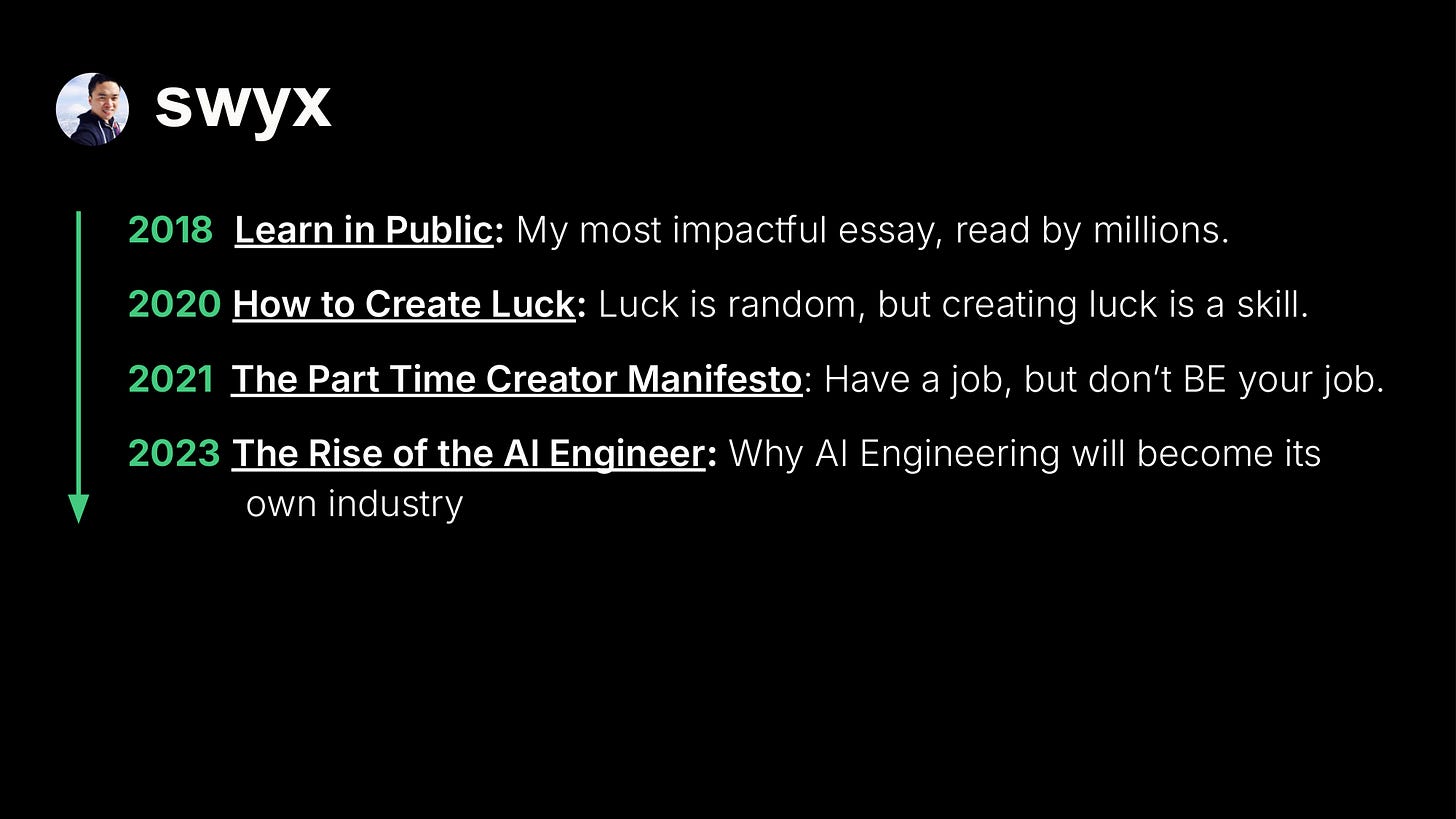
swyx’s key essays, each one a case study in the principles he shared with us.
This framework was four years in the making. It was first tested at a BBQ in our living room, with swyx literally presenting from the floor. We’ve refined it since.
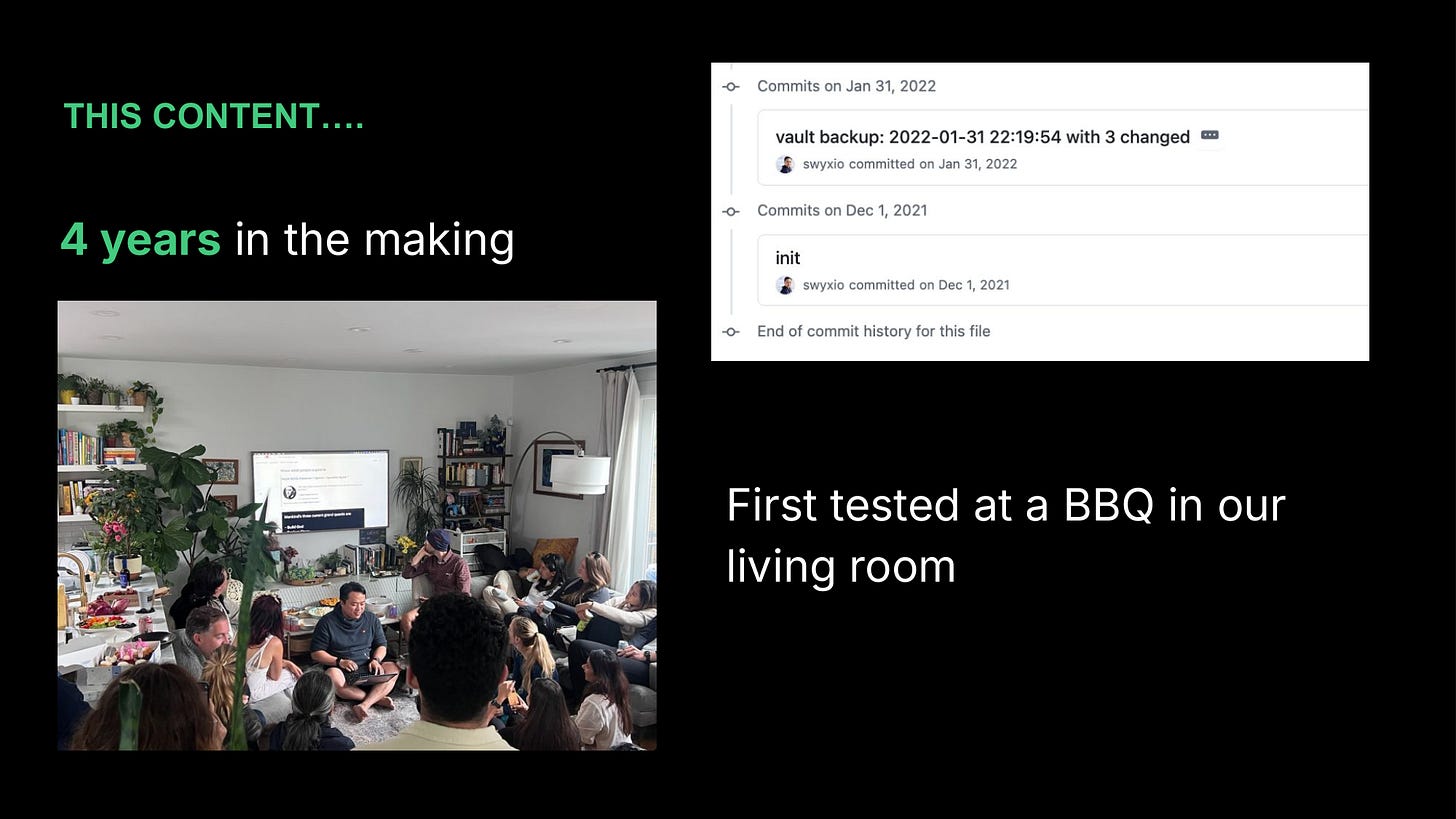
The first version of this talk, tested in our living room.
The One-Liner
If you remember nothing else from this post, remember this:
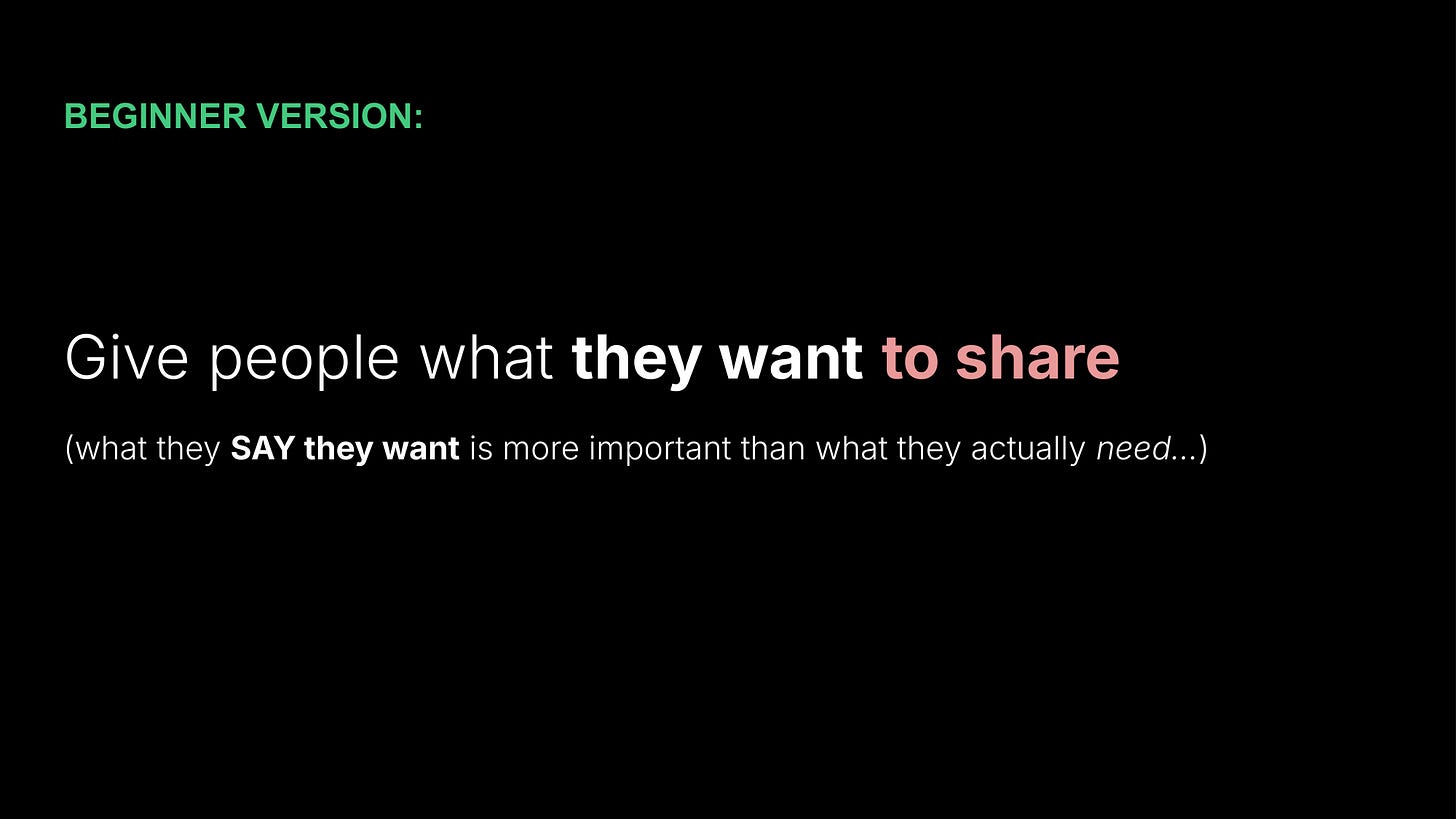
Not what they need. Not what’s most technically accurate. What they want to share. Because wanting to go to the gym and actually retweeting gym motivation are two very different things — and thought leadership lives in the gap between aspiration and action.
The serious version:
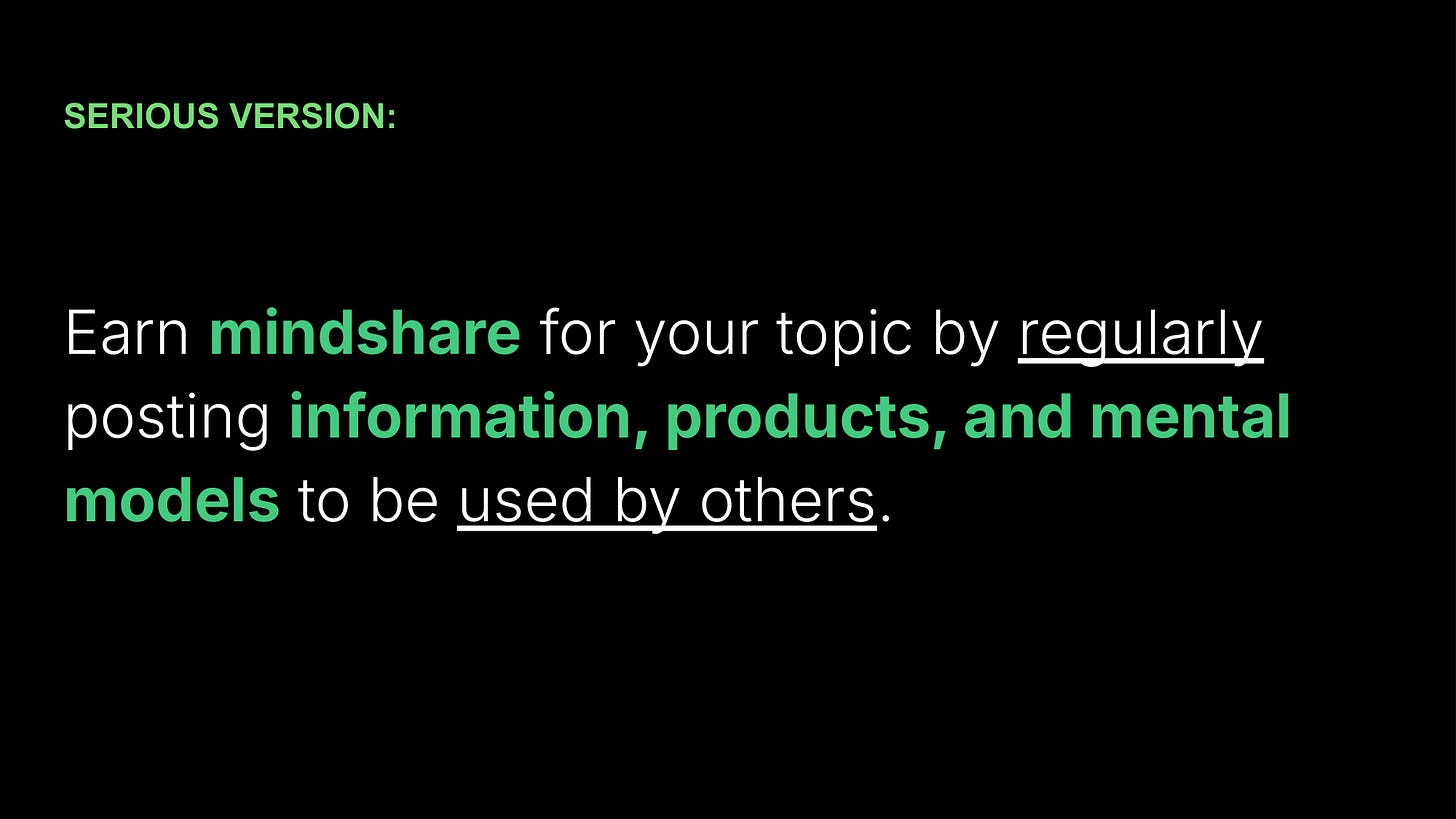
But swyx would be the first to tell you that definition is too wordy to be good thought leadership. The one-liner is better. That’s the point.
The Framework: 6 Rules, Ranked
swyx distilled everything he’s observed into six principles, explicitly in descending order of importance. The good thought leaders start from the top. The bad ones start from the bottom.
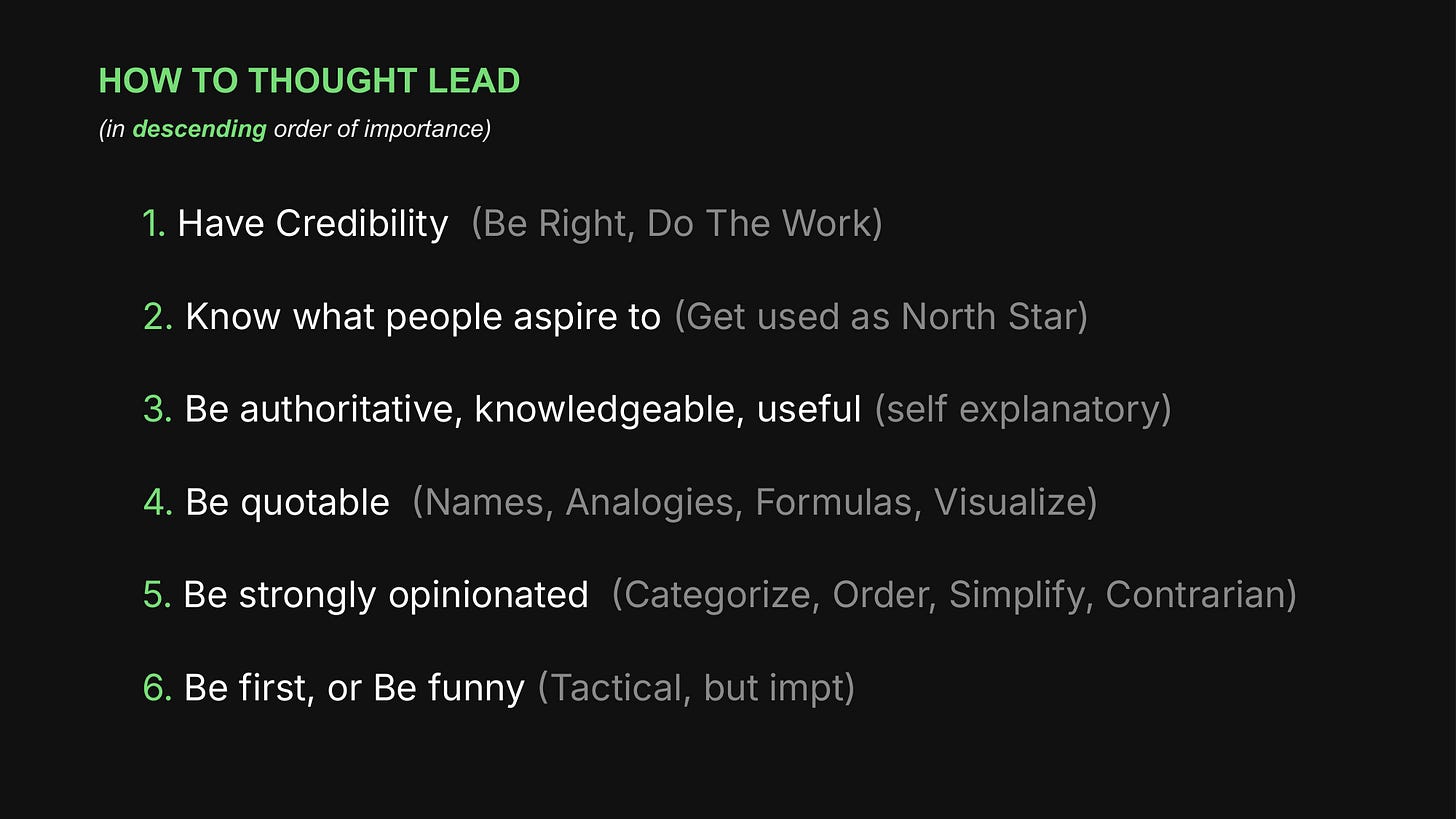
The full framework. The ordering is the insight.
1. Have Credibility (Be Right, Do The Work, Keep Neutrality)
This is the hard part. And it’s number one for a reason.
Do the work
swyx started making charts of LLM pricing versus ELO scores. The initial effort was two to three hours. But then every time a new model dropped, he’d update it in two minutes. That chart — that asset — got noticed by Demis Hassabis and became the lead image for Gemini 2.5.
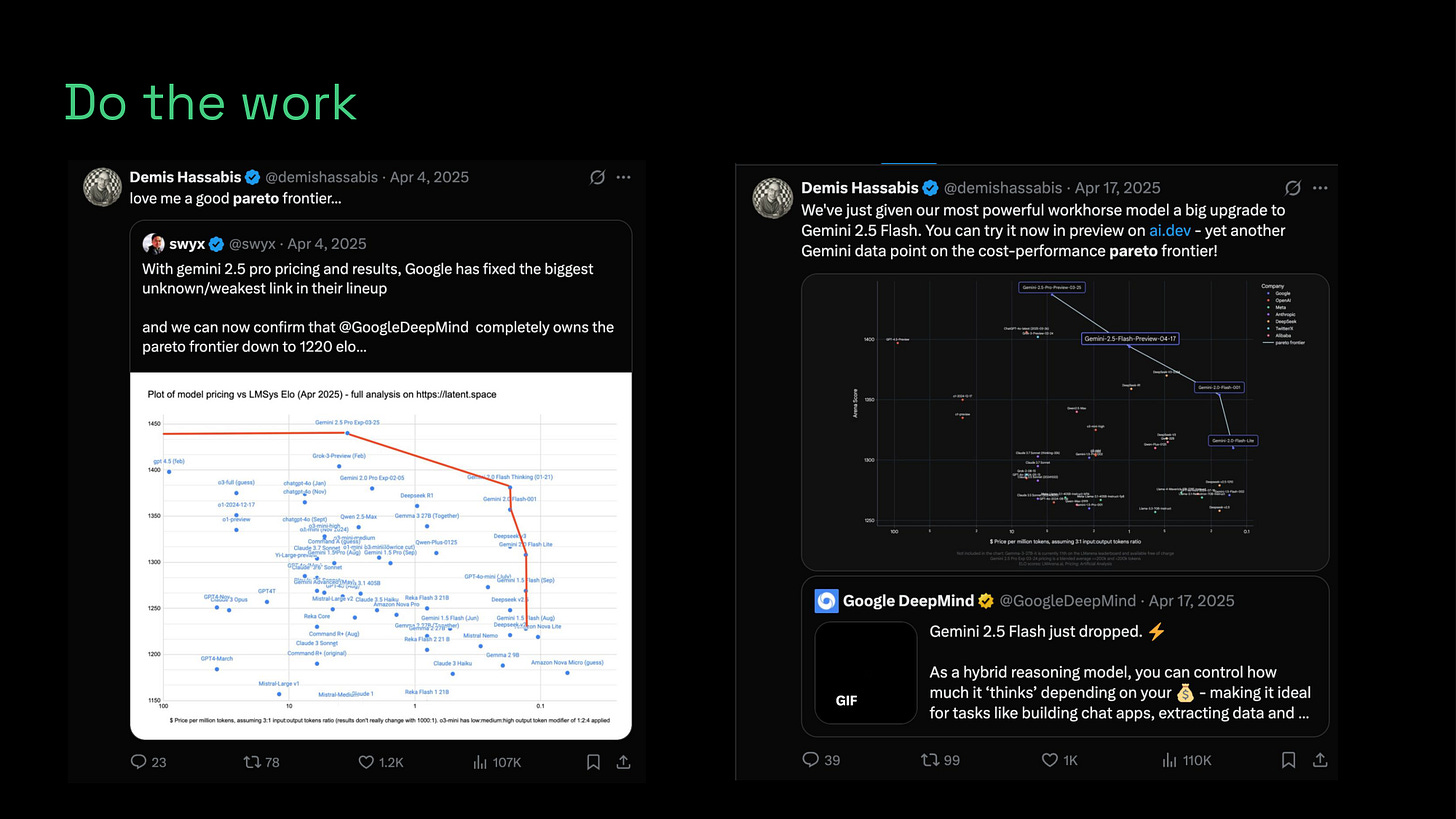
swyx’s pricing-vs-ELO chart got retweeted by Demis Hassabis and then used by Google DeepMind for the Gemini 2.5 Flash launch.
This is the key insight: most content is a sawtooth wave — you work on it, ship it, it drops to zero, and you start over. But an asset only grows in value. You build the data once, then every new event just adds to it.
The question swyx asks: “What chart do you wish existed every time you’re explaining something?” Build that. Then do it so well that others just re-share it.
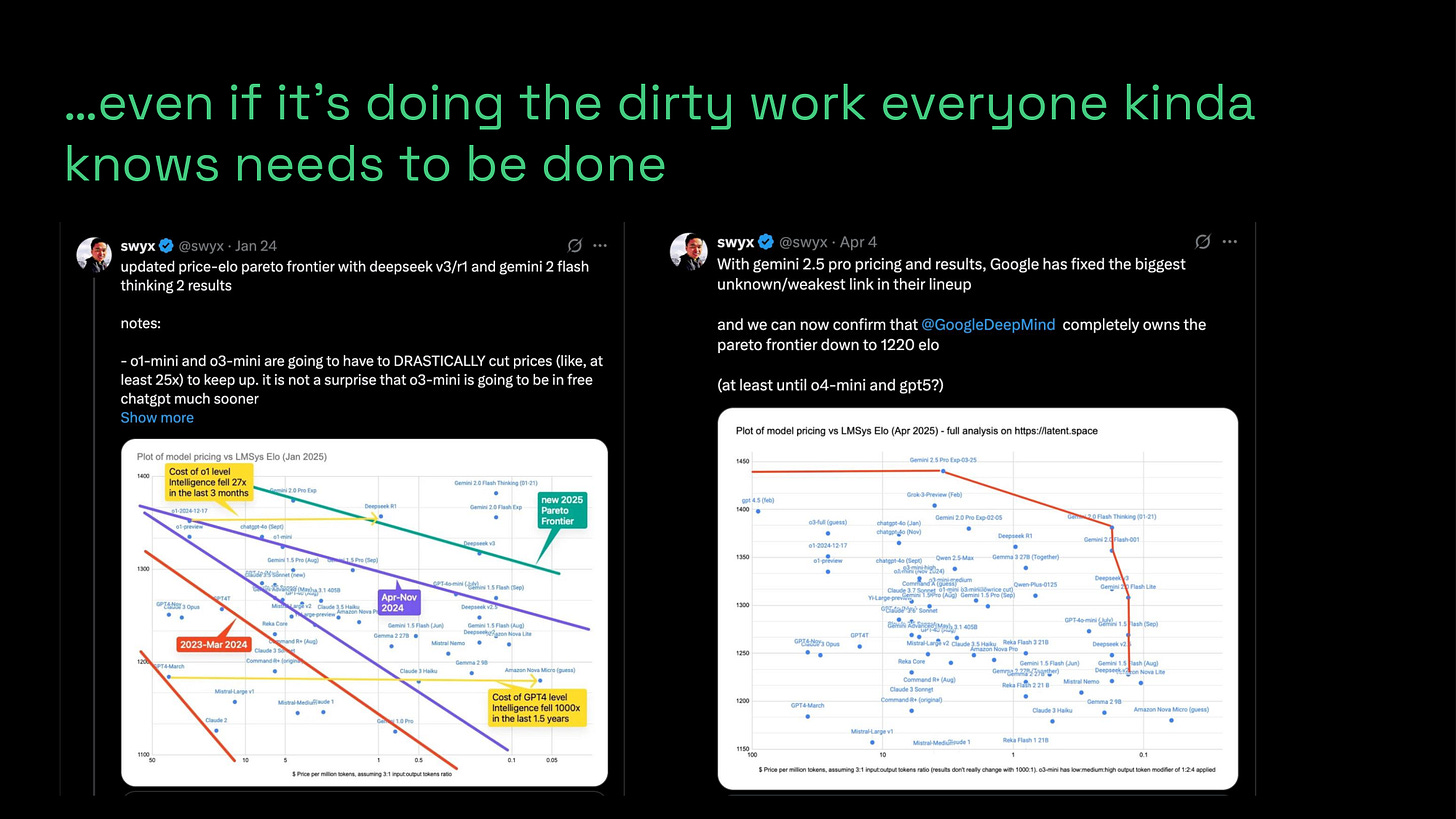
Anyone could have done this work. No one did. So swyx did, and it became the reference chart for the industry.
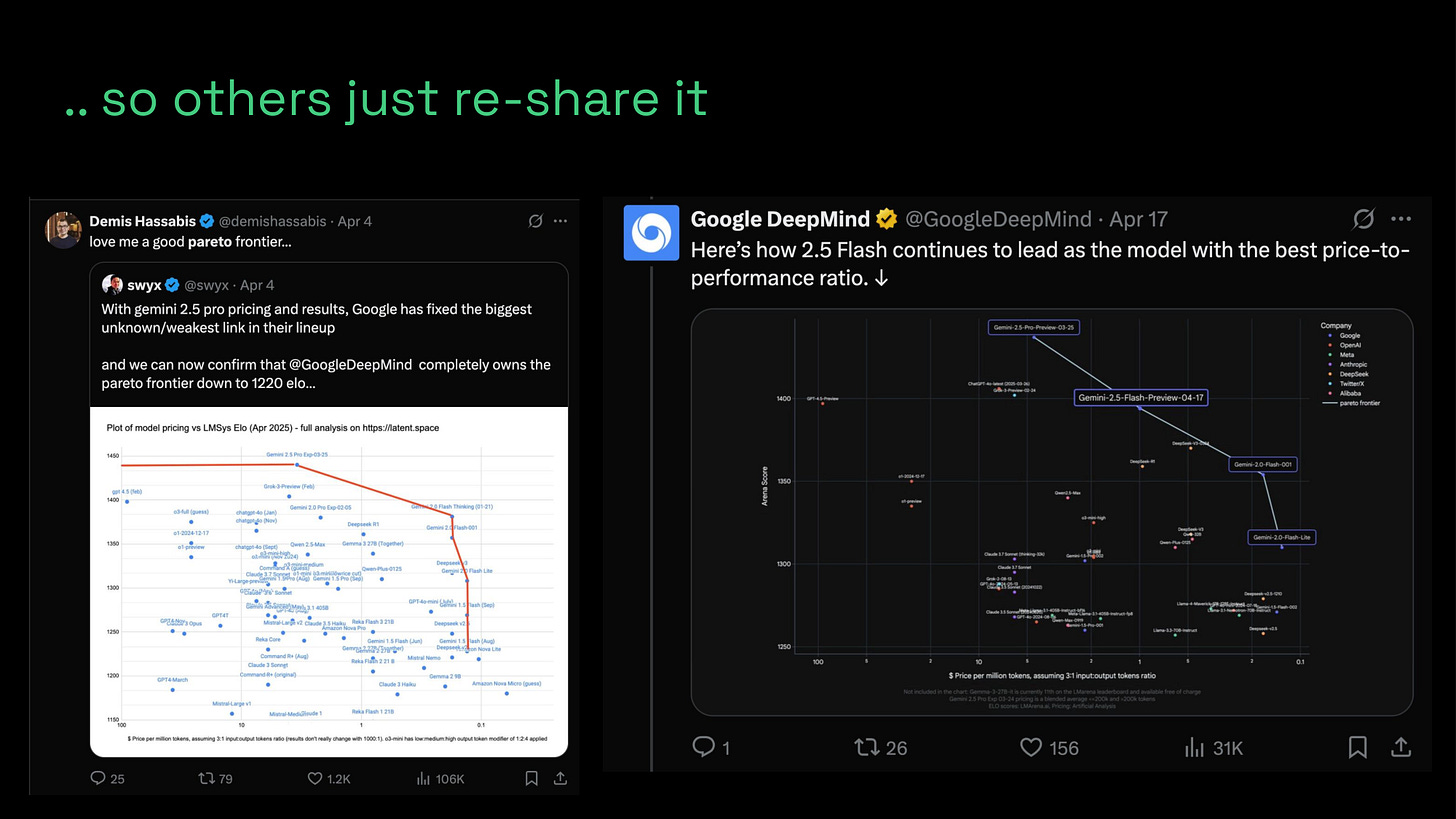
The payoff: when you do the work well enough, even Google DeepMind reshares your format.
Keep neutrality
swyx works at Cognition but still uses Cursor, still podcasts with competitors. That was explicitly part of the deal when he joined. As he put it:
“The true leverage in any negotiation is your true willingness to walk away.”
If he can’t maintain neutrality, he can’t do the job. And paradoxically, it makes Cognition look better — it’s a sign of security.
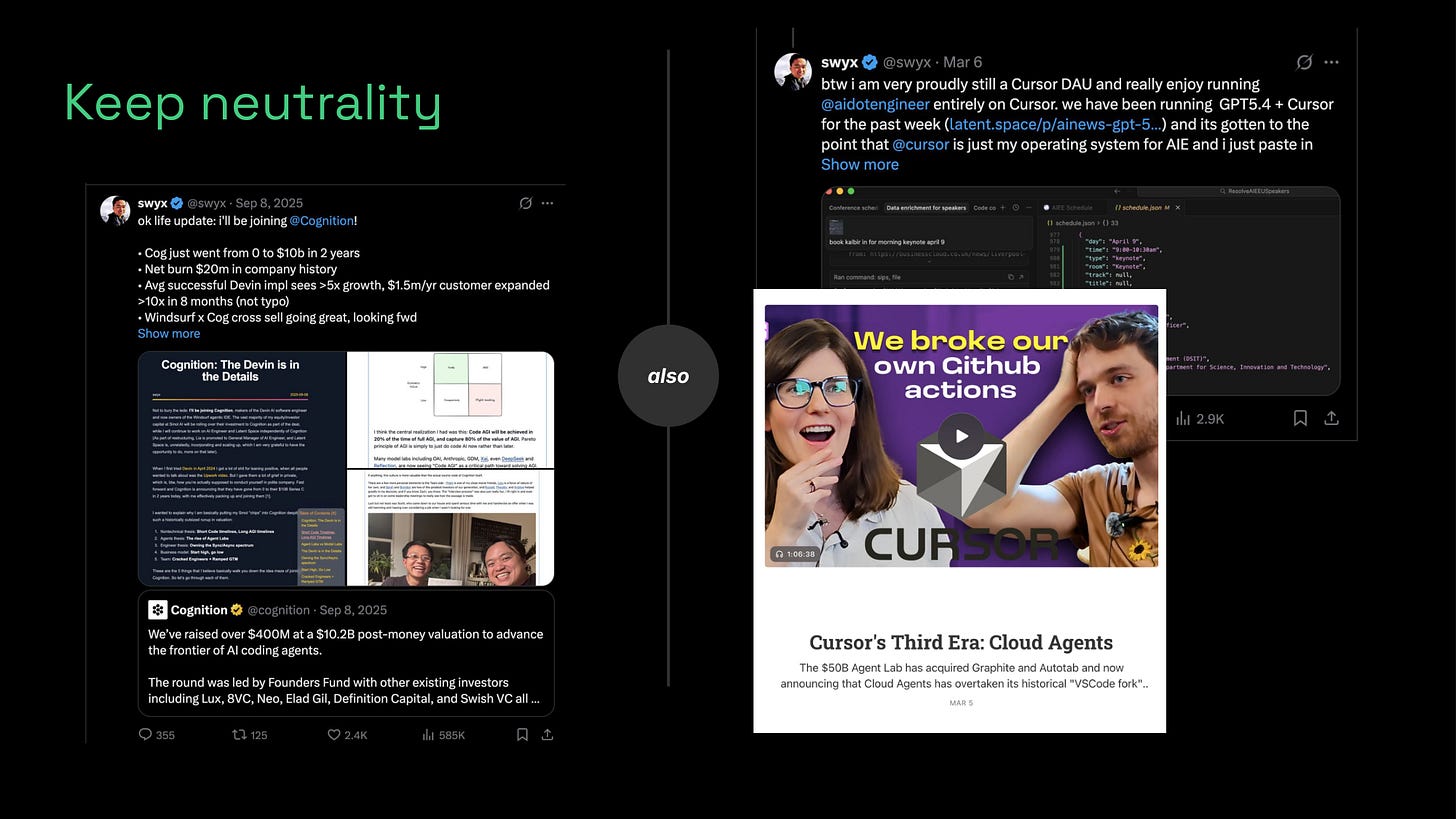
Joining Cognition while publicly praising Cursor. That’s what security looks like.
The deeper point: players who are also commentators give better commentary than people who are just commentators. Stock analysts who never invest have zero skin in the game. swyx calls this the Part-Time Creator Manifesto — the best thought leaders aren’t pure creators; they’re active participants who also share what they learn.
Credibility killers to avoid: getting into petty public fights, relentlessly plugging your company, refusing to celebrate a competitor’s wins. Lifting others up doesn’t take anything away from you. It makes you look better.
Be right
Amazon calls this “be right a lot” — swyx jokes it’s his most hated leadership principle. But there’s real substance here.
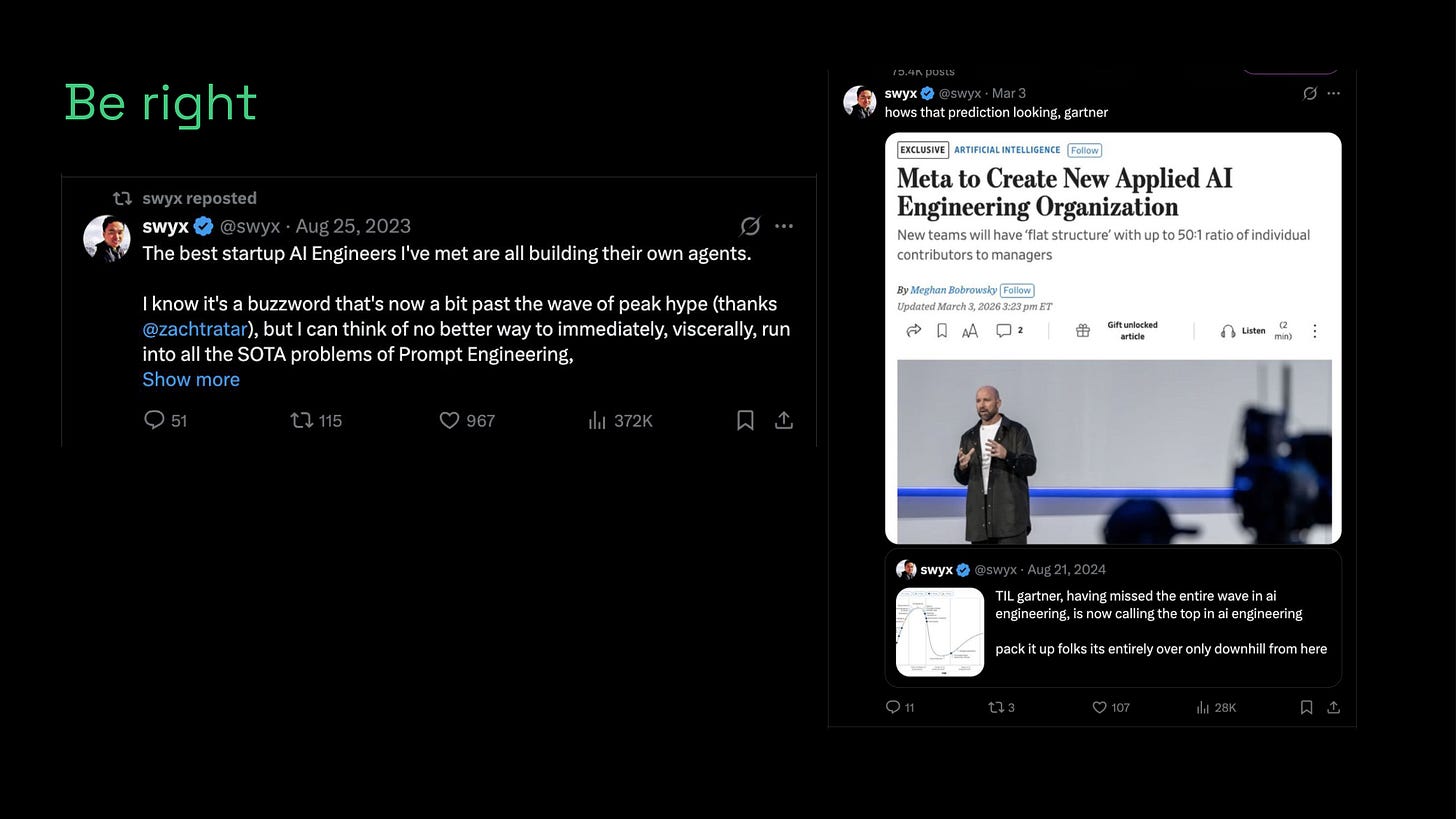
Left: swyx resurfacing a 2023 tweet that aged well. Right: calling out Gartner for premature predictions about AI engineering peaking — two years before Meta created a new Applied AI Engineering org.
swyx uses Twitter as a public note-taking tool and regularly resurfaces old tweets that aged well — a practice he calls macro-tweeting. When someone at his company said “Shawn is right a lot,” it was because they’d seen him retweet things from five years ago that turned out to be prescient.
Of course, you don’t retweet the stuff you were wrong about. But being right comes downstream of understanding your industry deeply, studying history, and mapping past patterns to the present.
2. Know What People Aspire To
This comes from Ralph Waldo Emerson:
“Our chief want is someone who will inspire us to be what we know we could be.”
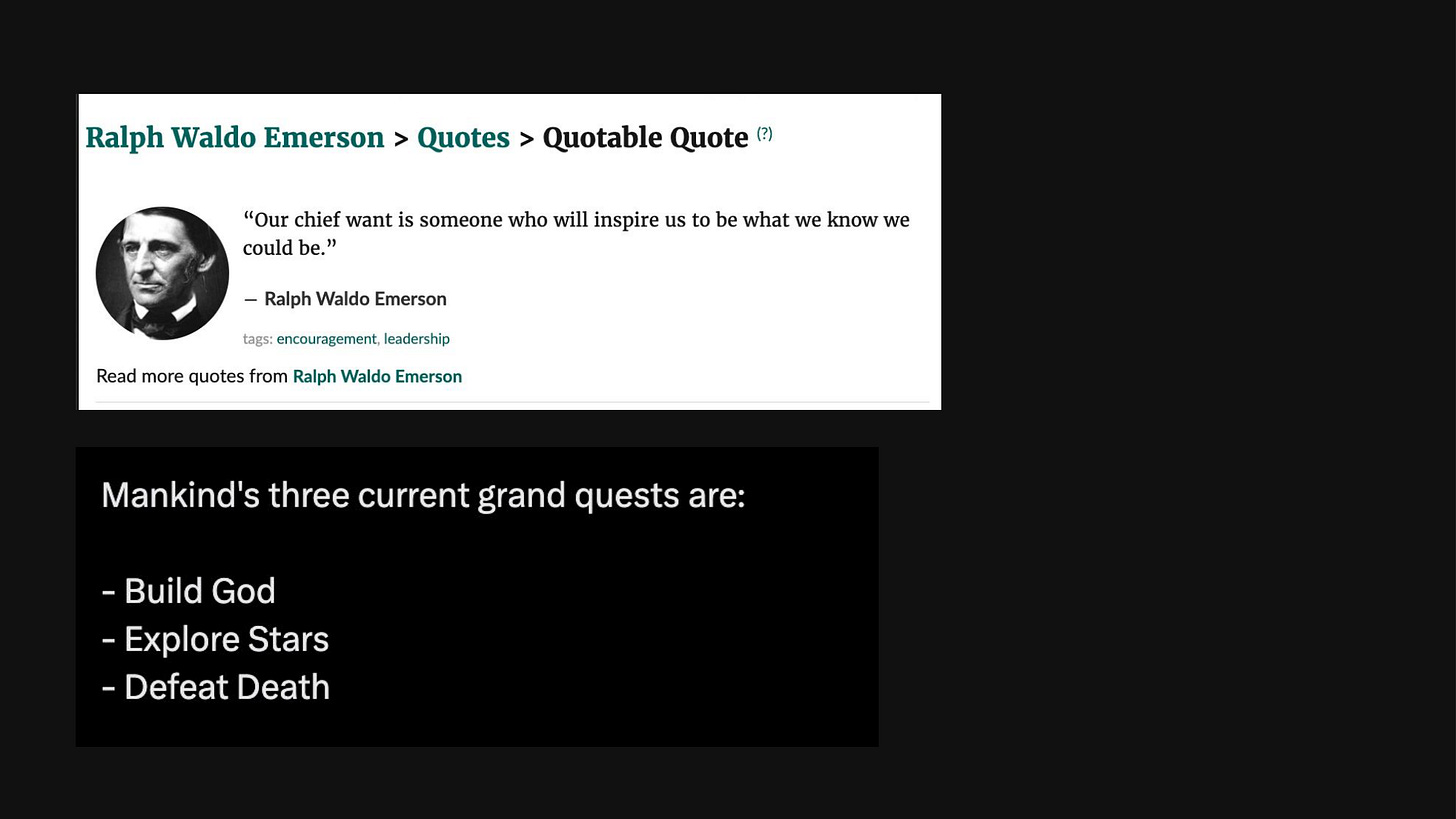
The aspiration level to aim for: Build God, Explore Stars, Defeat Death. Not “optimize your click-through rate.”
The worst of social media feeds your basal instincts — cute puppies, shocking headlines, things that will never affect your life. The sweet spot for a thought leader is to lead people toward where they wish they could be.
swyx frames it beautifully:
“People want to be the person their bookmarks reflect, not what their feed reflects.”
Bookmarks are your stated preference. Your feed is your revealed preference. The real word-of-mouth — people telling each other about you — comes from aspiration.
You don’t have to be the canonical ideal. You don’t have to be perfect. You just have to stand for a thing and be very loud about it. Brian Johnson probably has cheat days, but he’s “the health guy.” He’s the shorthand, and he wants to be the shorthand.
Grand challenges are a long tradition of this:
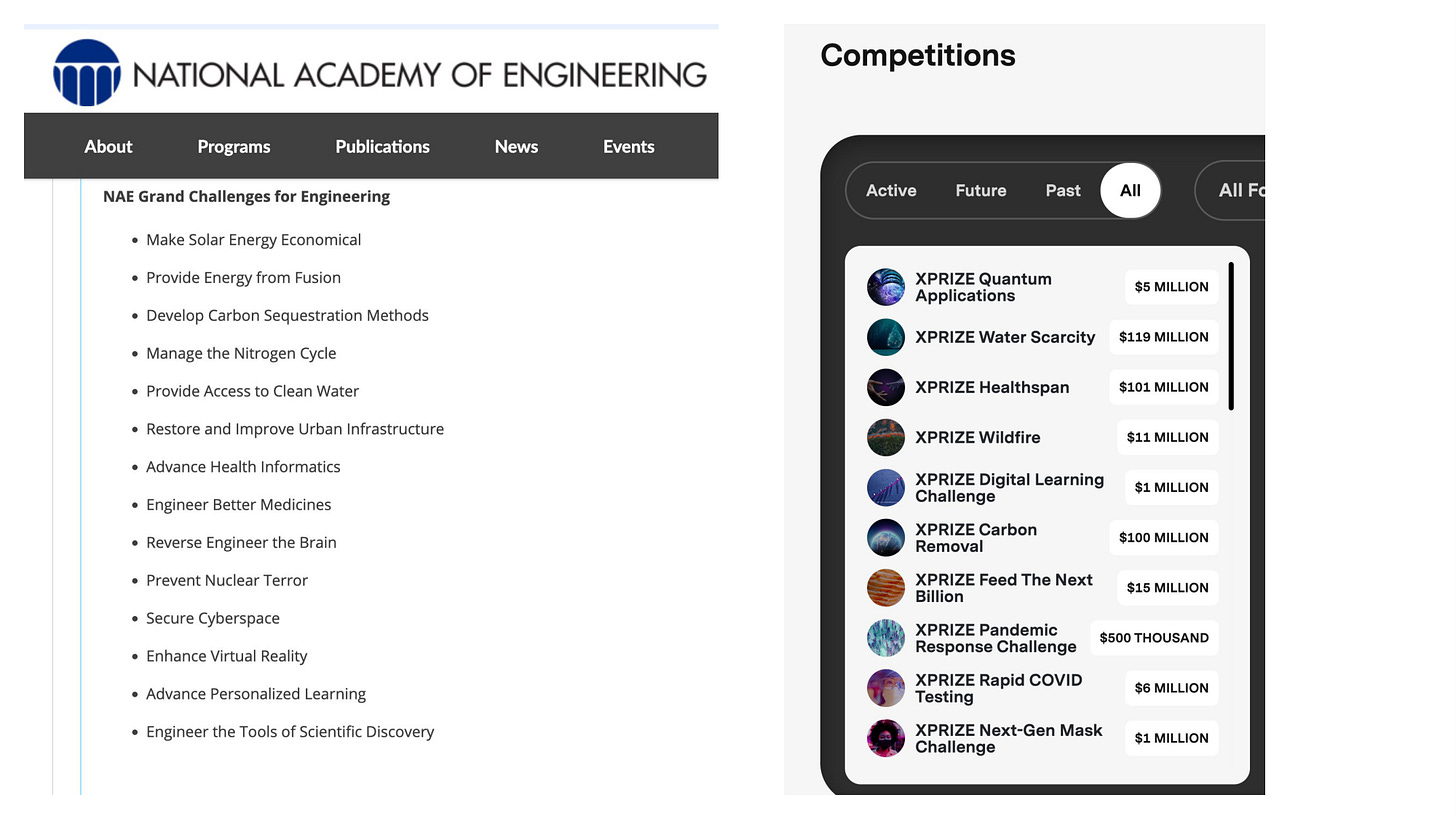
Make solar energy economical. Provide access to clean water. Prevent nuclear terror. If you solve it, everyone applauds. You hire better. You fundraise better.
Once you identify the aspiration, you build backward from there. But if you don’t have a good aspiration, you’re dead on arrival. Nothing you do will matter because you just didn’t aspire to anything useful.
3. Be Authoritative, Knowledgeable, Useful
This is the L1 cache of doing the work. Have things in memory so that when you’re on a podcast or live interview, you can recall them instantly. People get invited to things not because they talk well, but because they have better facts than anyone else.
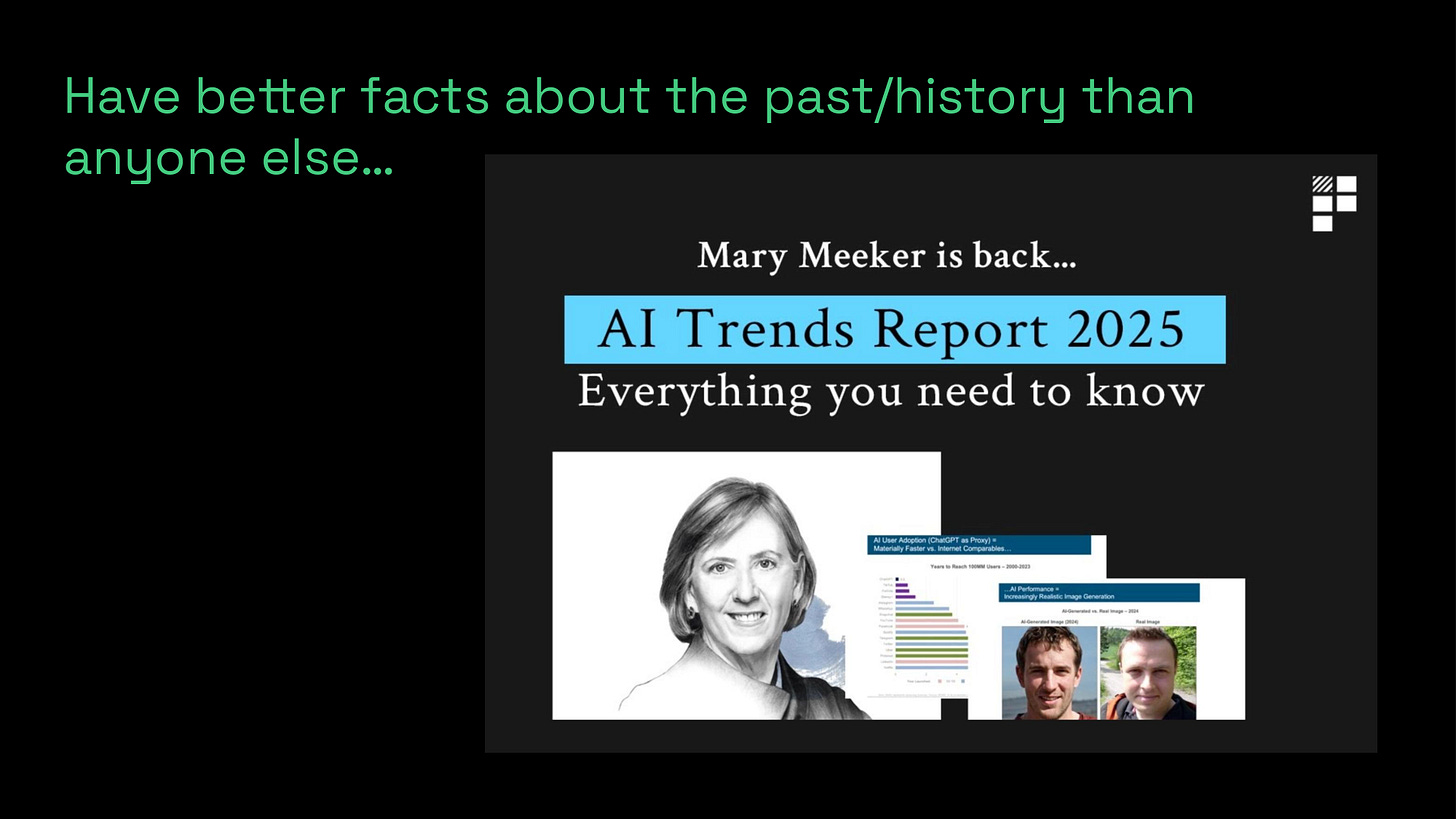
Mary Meeker built her entire career on one 500-slide presentation per year. When she drops her report, it’s an event.
Mary Meeker used to present the Internet Trends Report at Morgan Stanley during Web 2.0. Now she does AI trends. swyx has no idea what she does with the other 364 days of her year, but it doesn’t matter. When she drops her report, it’s an event. Then she goes around the world talking about it. That is thought leadership.
The other move: draw lines on charts. Take 50 data points and reduce them to three that really matter. That insight — the reduction of dimensionality — is the value add that others haven’t done.
4. Be Quotable (Names, Analogies, Formulas, Visualize)
swyx learned this from Kelsey Hightower, who led developer relations for Google Cloud and Kubernetes: everything he says on stage, he’s written down before. He’s worked on making it quotable. He’s gone through different variations. Because when you have the pull quote — that’s the thing people share, put in titles, and tweet about.
If you haven’t worked on being quotable, you’ll have less success than someone who has. And people are working on it.
Name things with two words
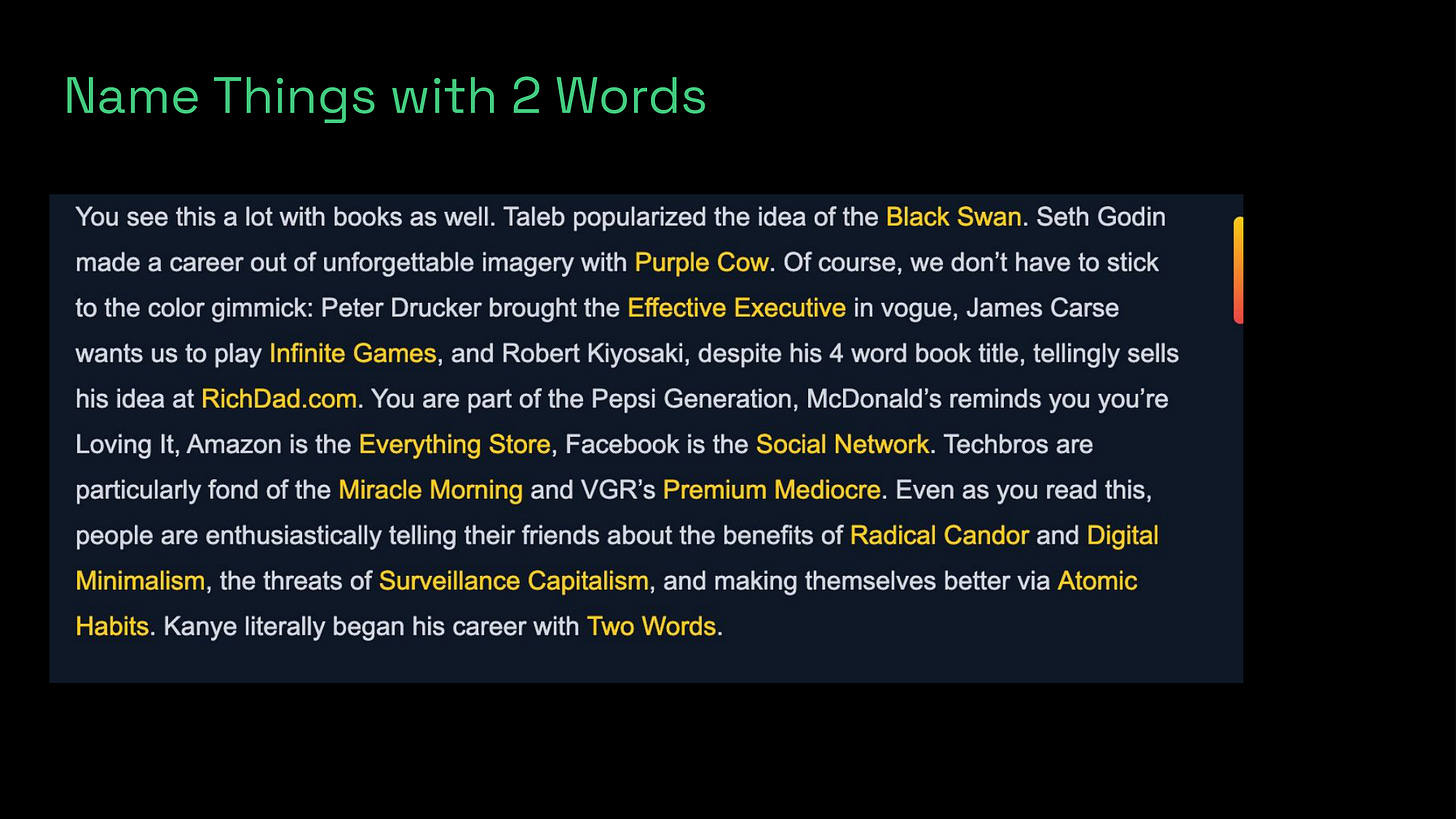
Black Swan. Purple Cow. Infinite Games. Everything Store. Social Network. Kanye literally began his career with Two Words.
Why two words? Everything longer can probably be reduced to two. Everything shorter (one word) is too generic. Two words is the minimal atom of virality. It should be immediately unpackable by people with no further context.
swyx’s own two words? AI Engineer.
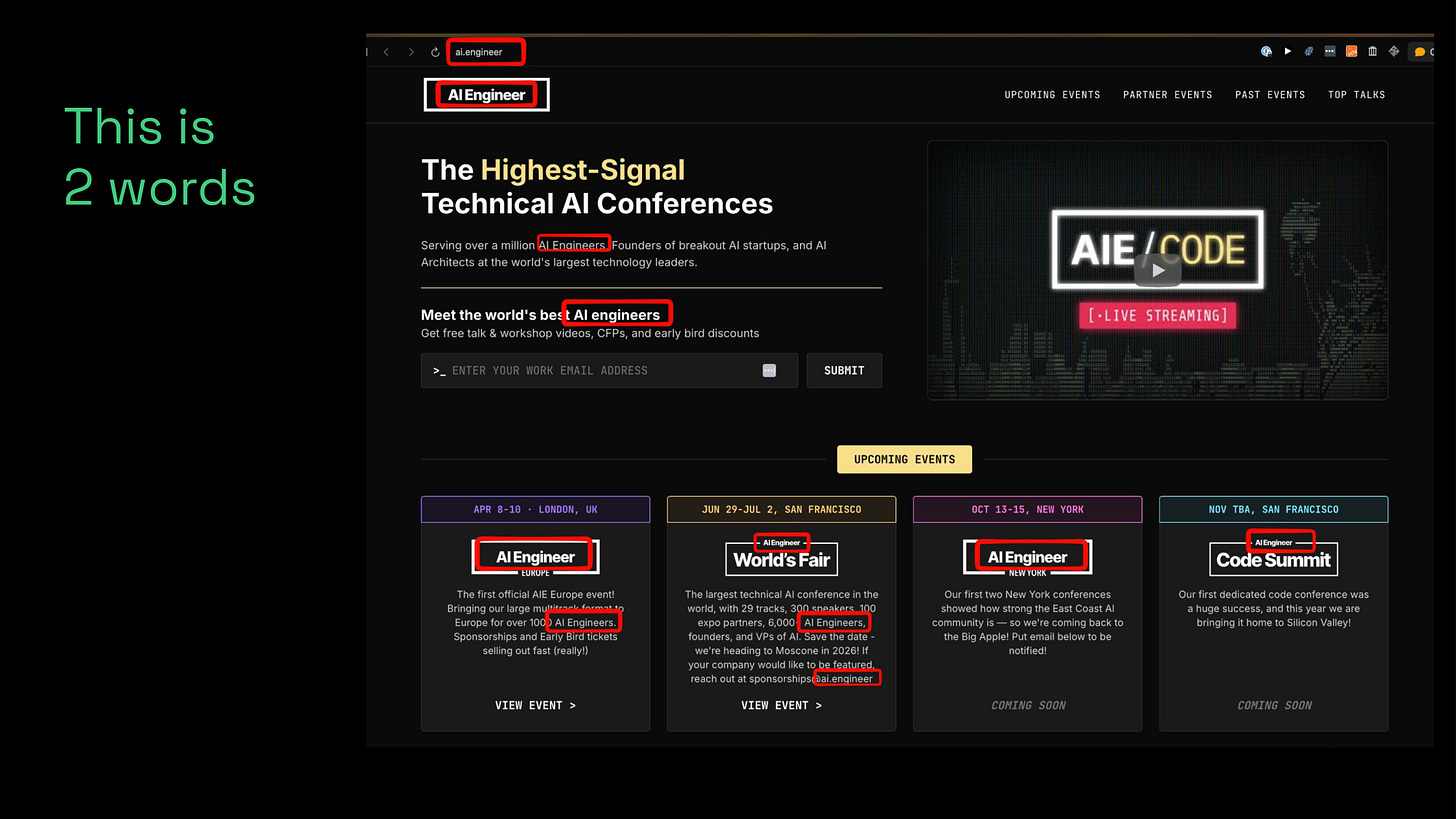
Two words that became a conference, a YouTube channel with 374K subscribers, a job title, and an industry.
Name the problem
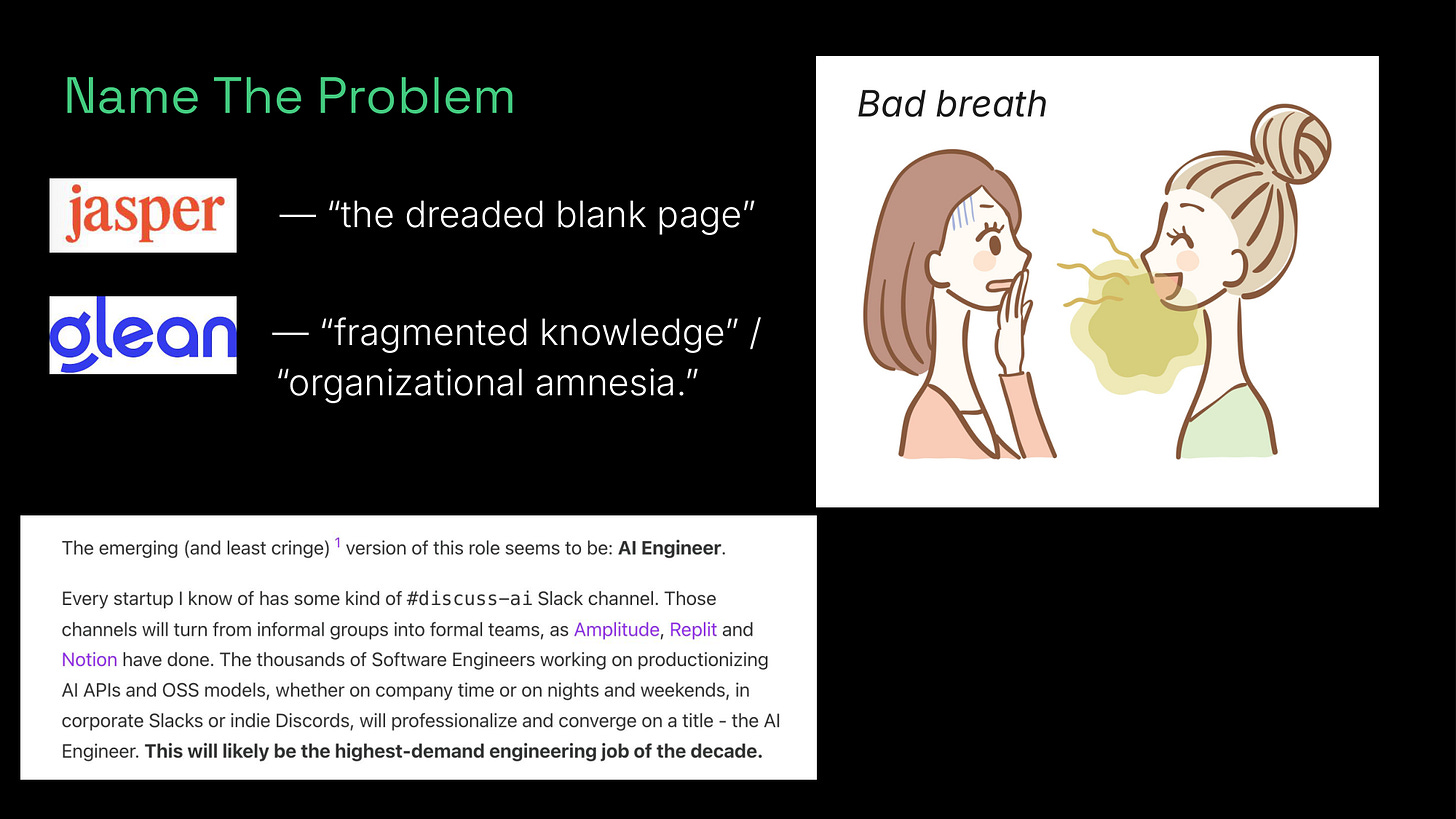
Whoever created toothpaste invented “bad breath” to give people two words to identify the problem that leads to the solution.
Jasper talks about “the scary blank page.” Glean talks about “organizational amnesia.” For AI Engineer, swyx identified the demand-supply problem: app developers wanted a place in AI but were being denied by traditional ML researchers. Companies wanted to hire engineers who were good at AI but not PhDs. He just created a shelling point for demand and supply to find each other.
Categorize things
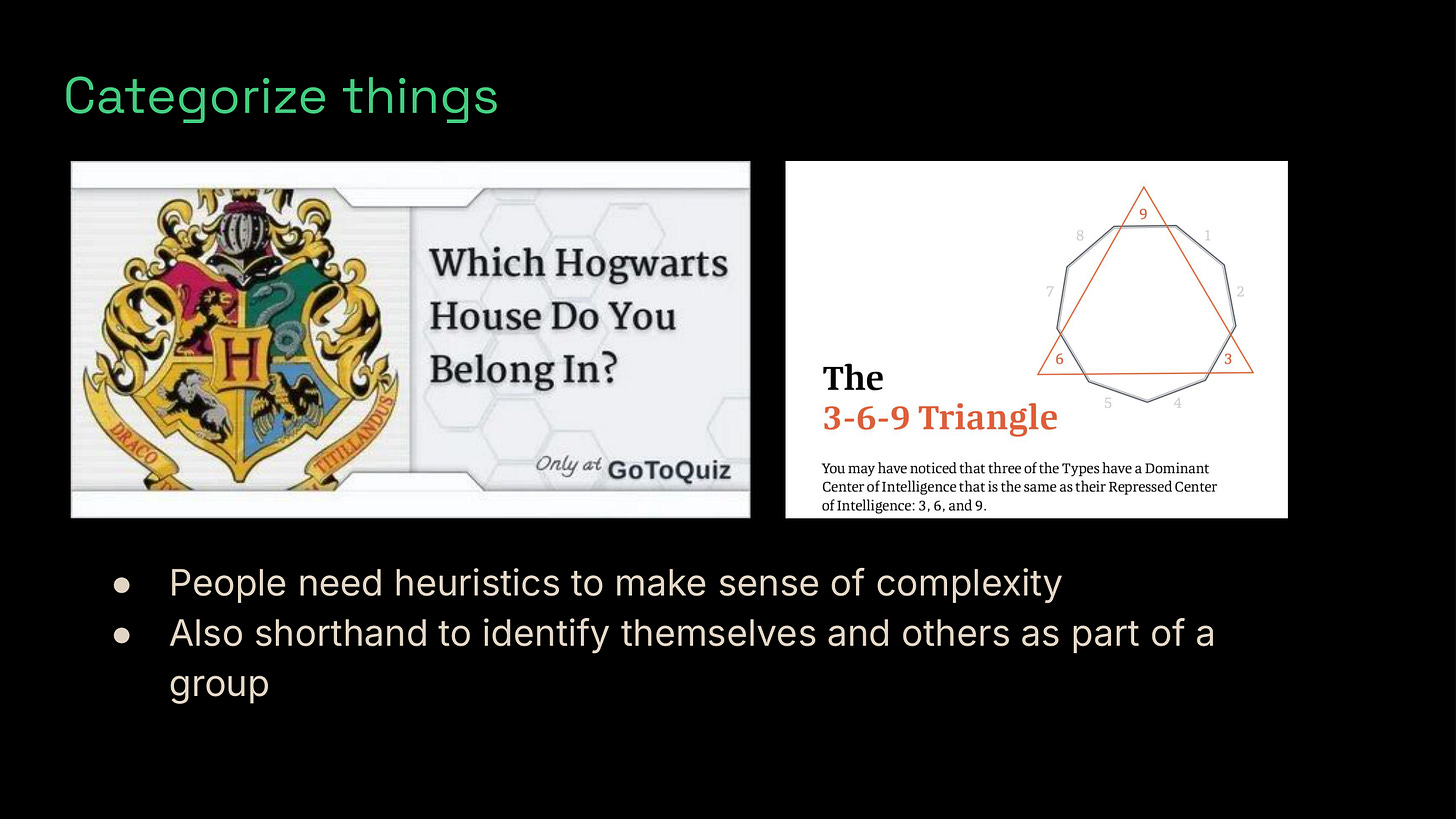
People love to play Hogwarts. Which house are you?
Everyone knows personality quizzes are kind of silly, but they’re insightful. People love to classify themselves and ask each other their classification. Evolutionarily, we want an ingroup and an outgroup. Your job as a thought leader is to create the boxes. Once people put themselves in your boxes and find them useful, they’ll spread them for you.
swyx did exactly this for AI Engineer — putting research scientists and ML researchers in one box, data engineers and ML engineers in another, and creating a new, aspirational box in a different color:
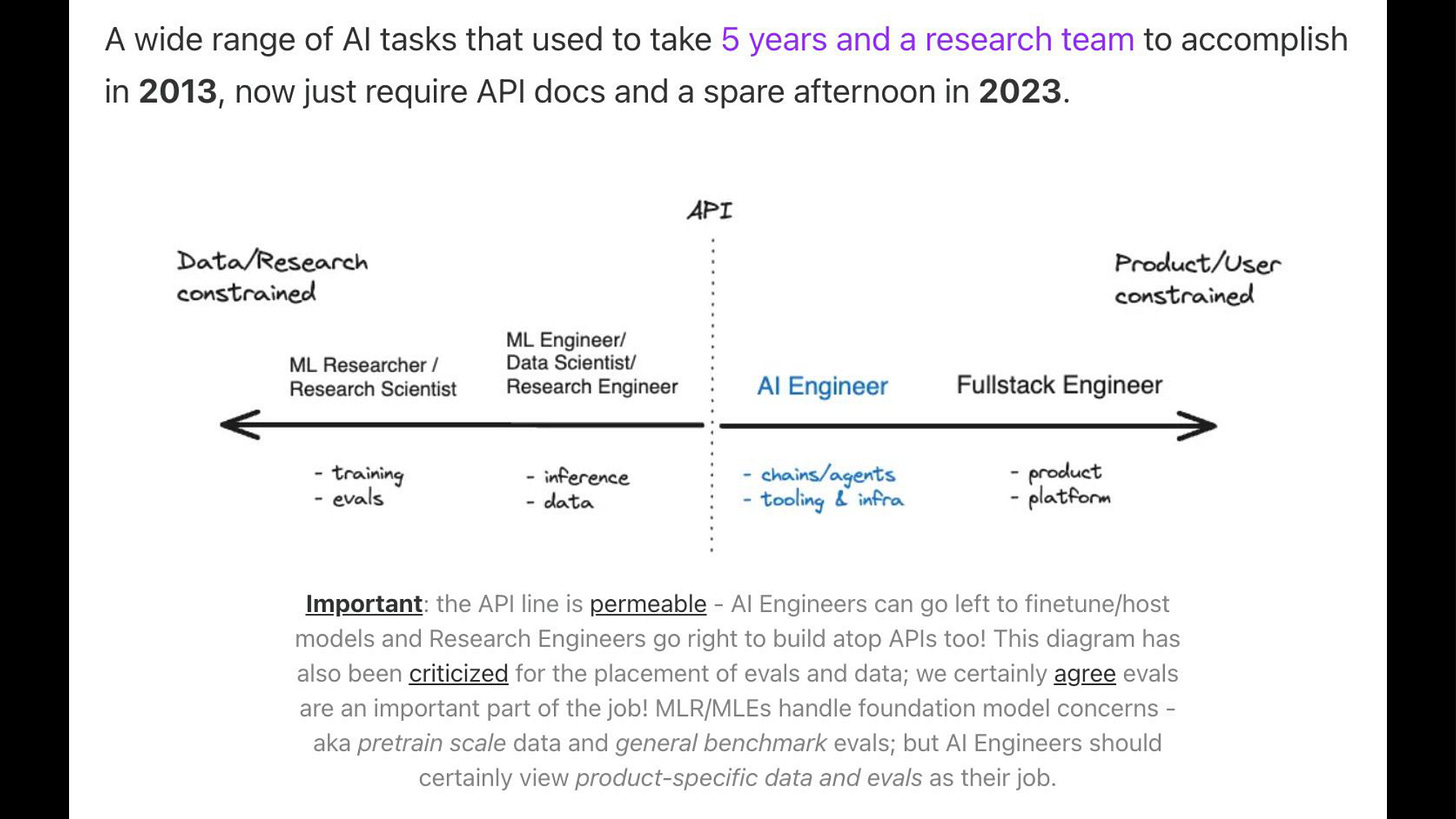
Create your box. Make it a different color. Make it aspirational.
Visualize things
A map is a particularly powerful form of visualization. Everyone agrees on the location of continents — that’s objective. Everything you overlay on top is subjective. But because you drew the map, you get to call anything whatever you want. You borrow the credibility of something objective and overlay something subjective.
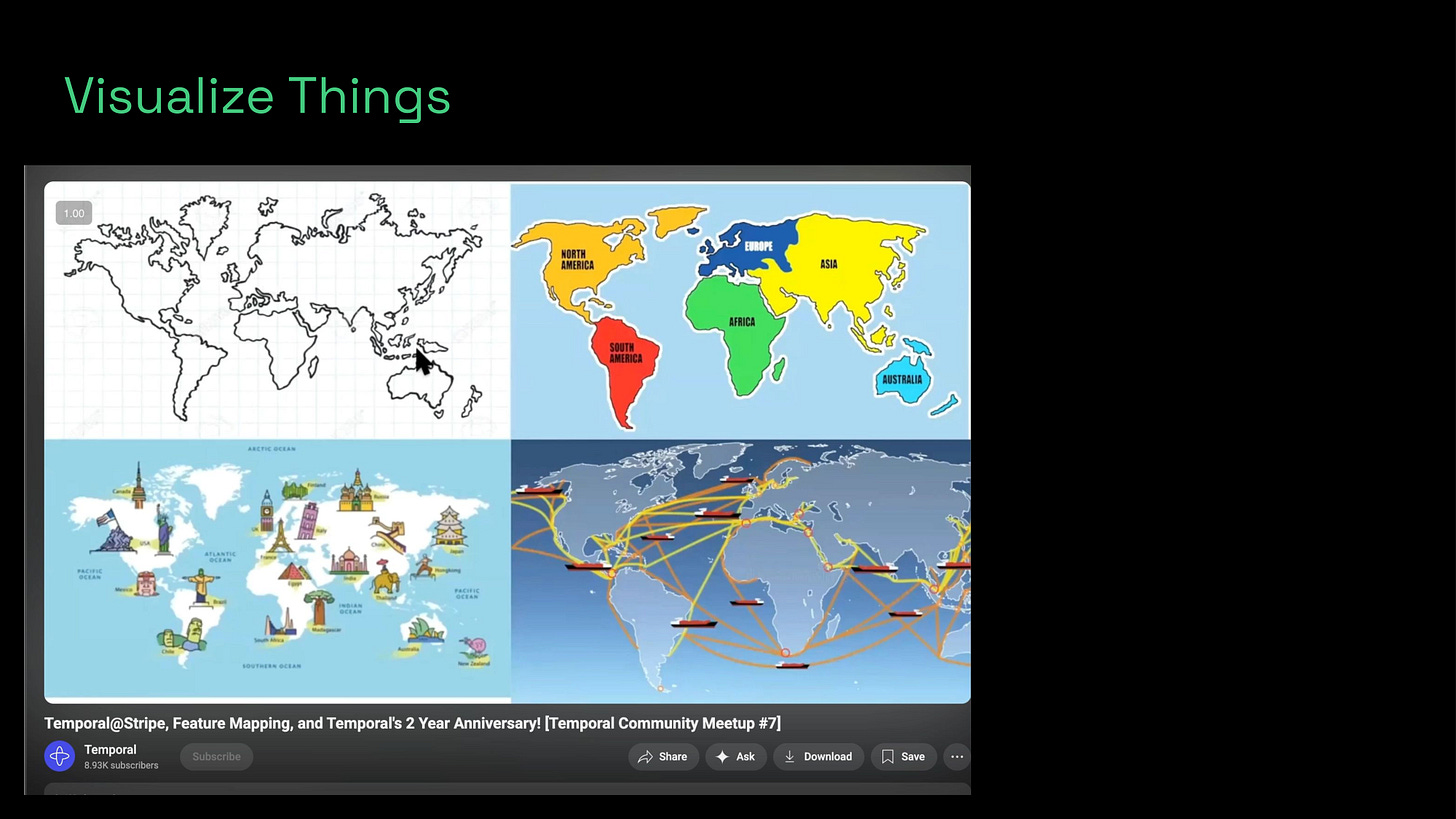
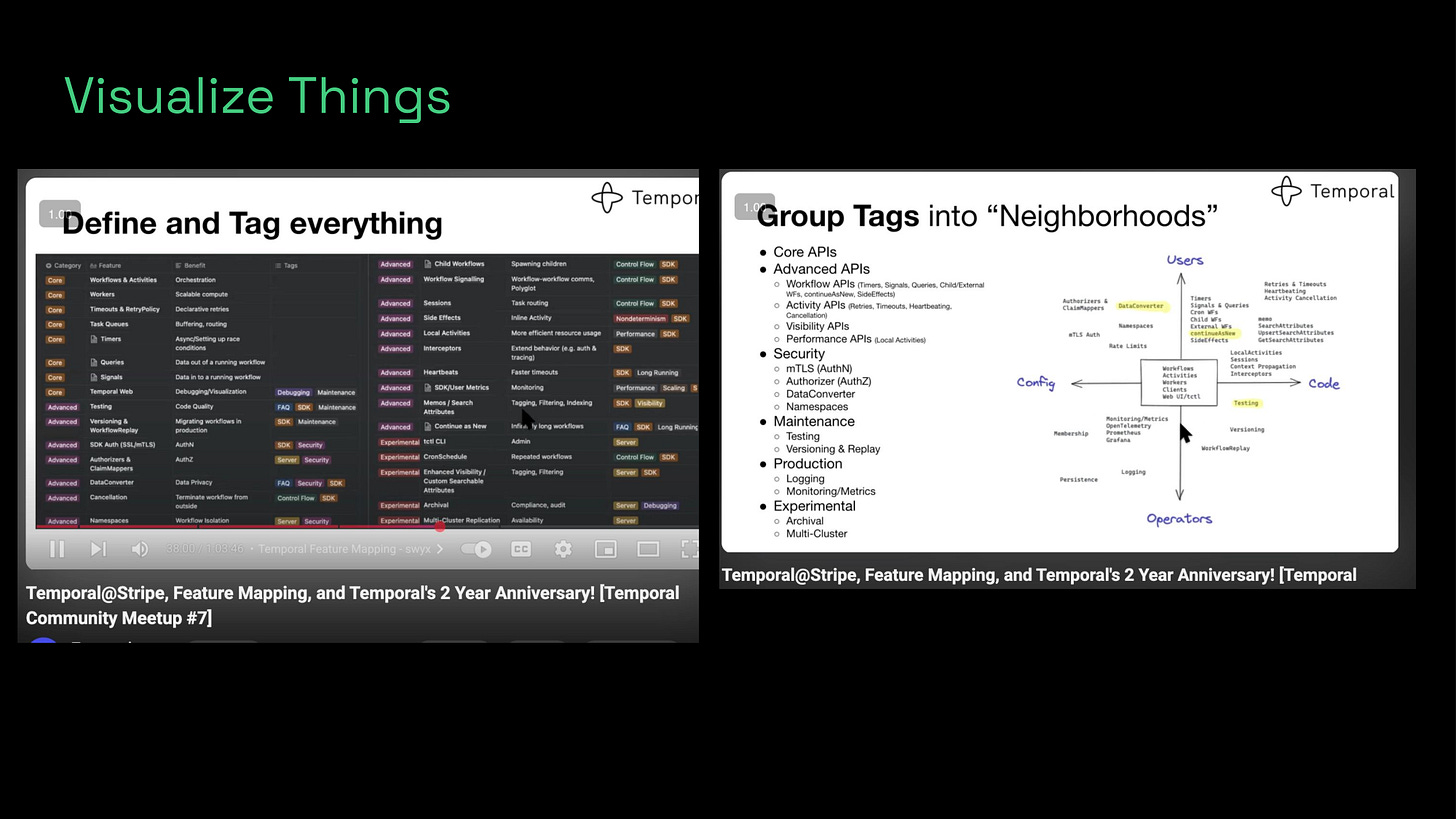
swyx mapped Temporal’s ~200 features into “continents” and “neighborhoods” — turning chaos into a navigable map. When the map ends, you know you’re done.
Good visuals travel much further than good text. You know a meme truly made it when even your parents send it to you:
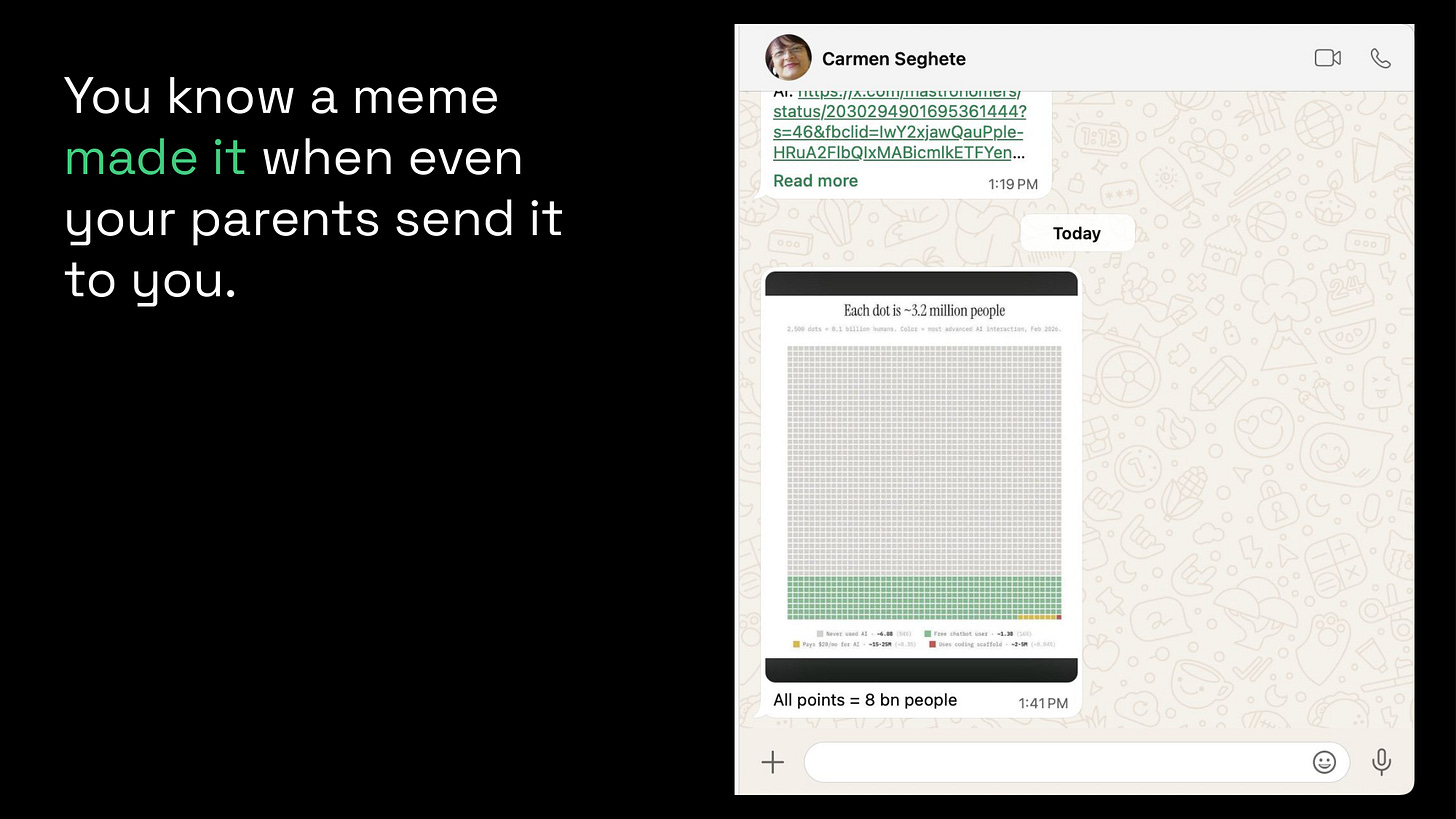
My mom from Romania sent me this AI visualization on WhatsApp. That’s when you know it worked.
Create Equations formulas
The easiest form of visual is a formula: A + B + C = thing everybody wants. Three is a good number — simple enough to repeat and understand, high enough to feel substantive. Make sure the factors are MECE (mutually exclusive, collectively exhaustive).
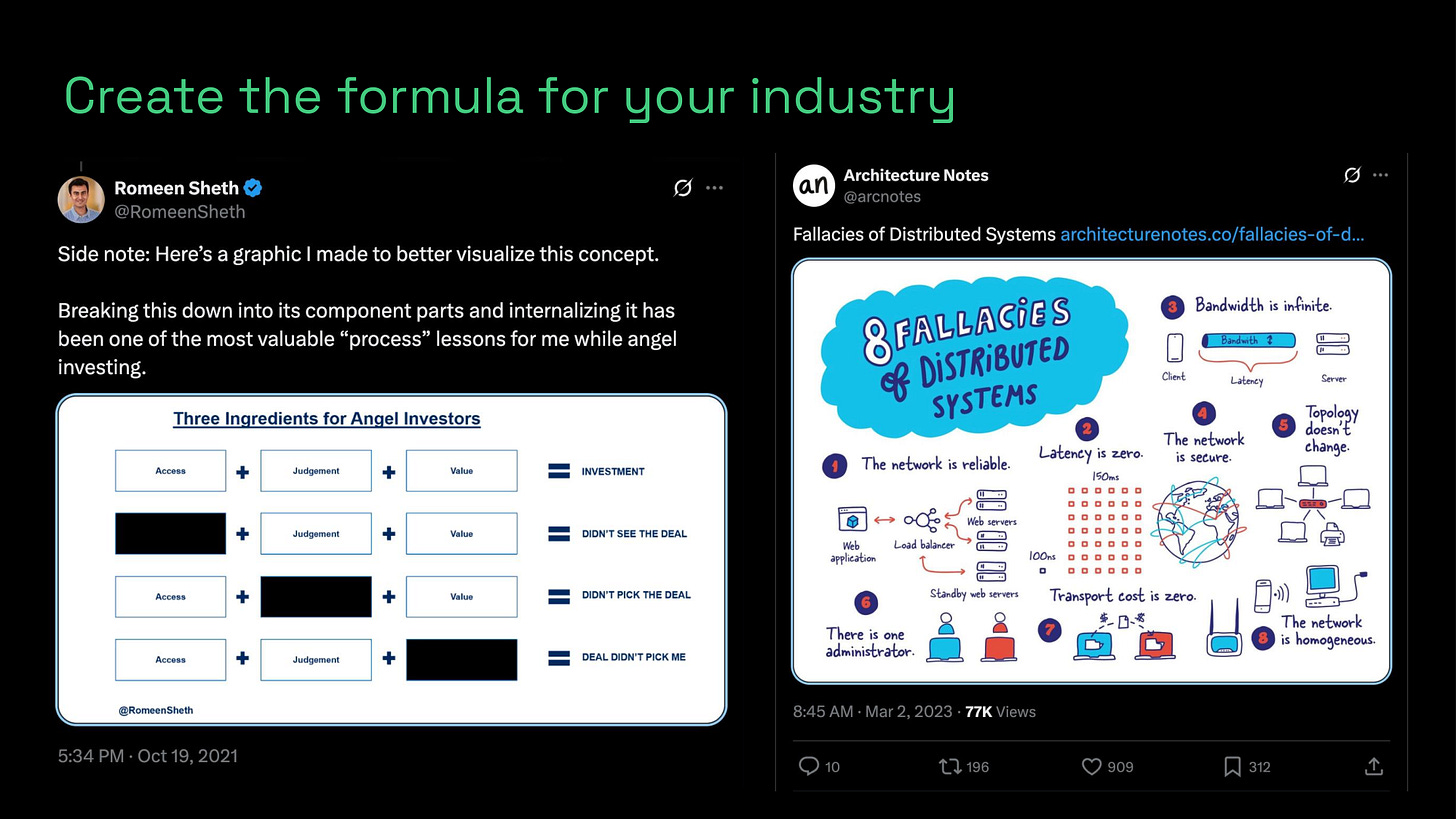
Left: Access + Judgment + Value = Investment. It’s “fake math” — but three is a really good number for creating a viral visual. Right: The 8 Fallacies of Distributed Systems, illustrated — a 1960s paper someone visualized and it got shared everywhere.
Edit: see Alex Hormozi's "Value Equation"
Here’s another formula that doesn’t look like one but absolutely is:
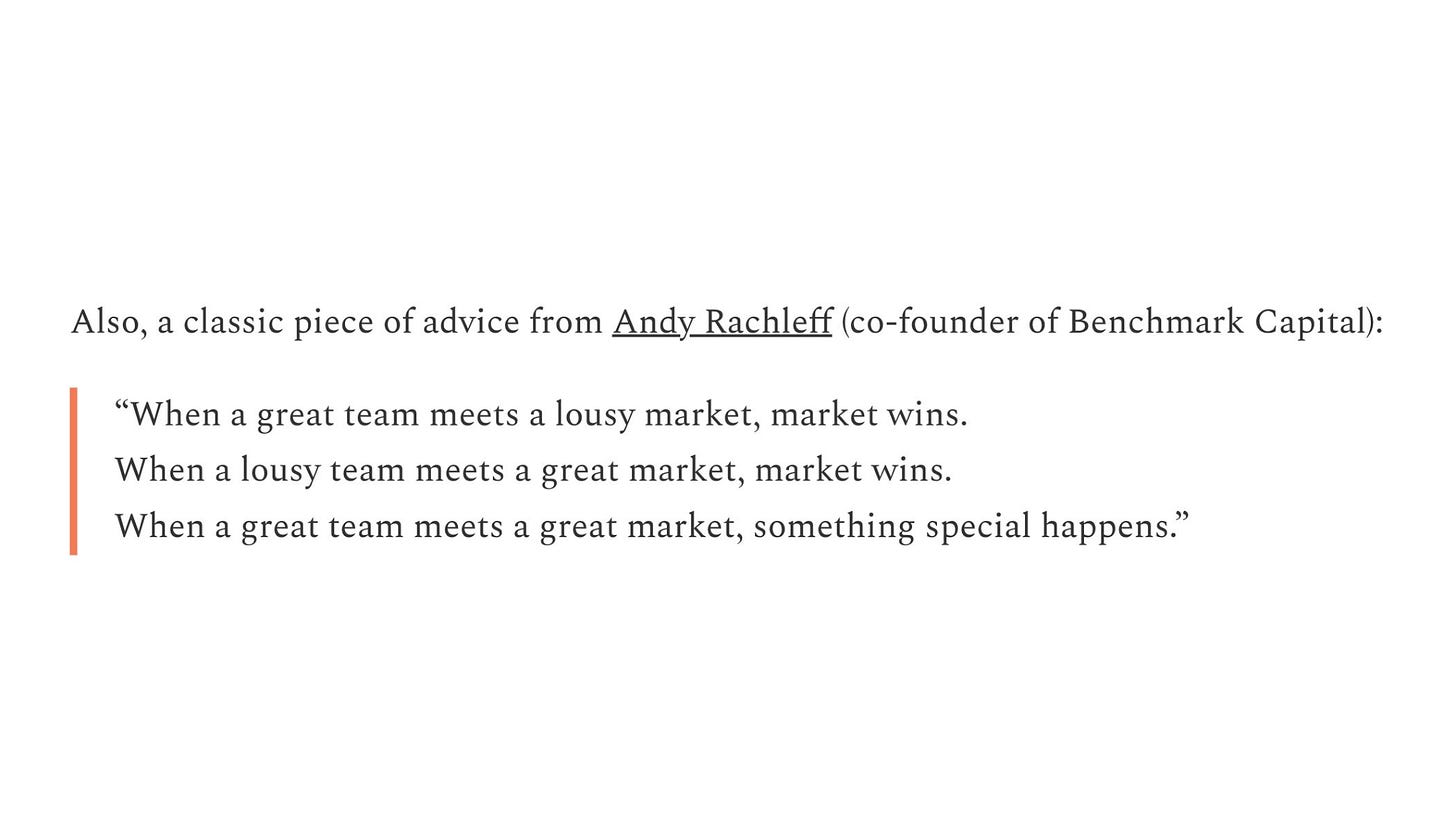
Andy Rachleff’s formula. Quotable AND a formula. That’s double thought leadership.
Build analogies
Andrej Karpathy loves analogies — and they stick immediately:
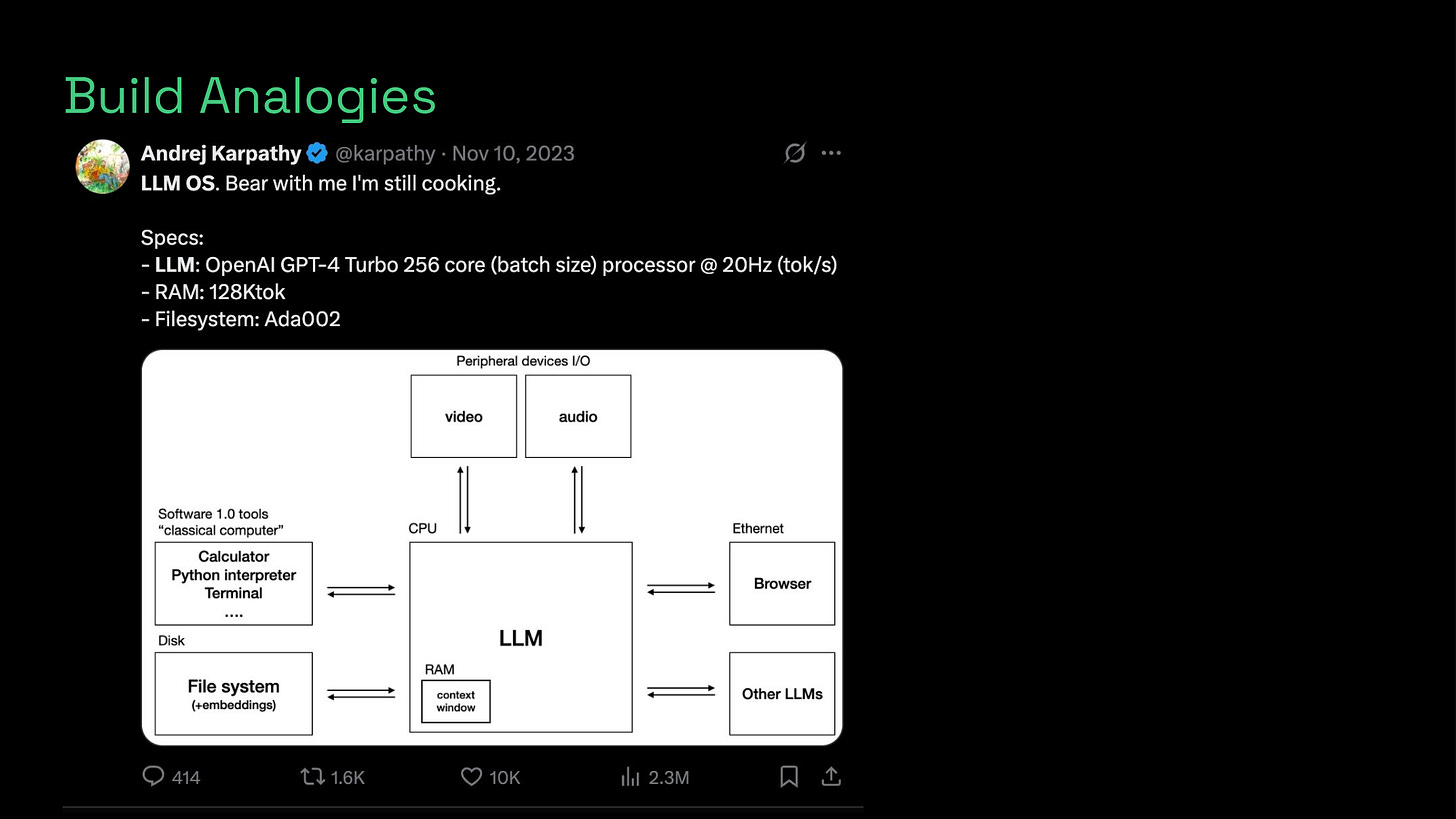
Karpathy’s “LLM OS” analogy: 414 comments, 1.6K retweets, 10K likes, 2.3M views. Two words, one diagram.
Steve Jobs created “bicycle for the mind” — quoted endlessly, long after his death.
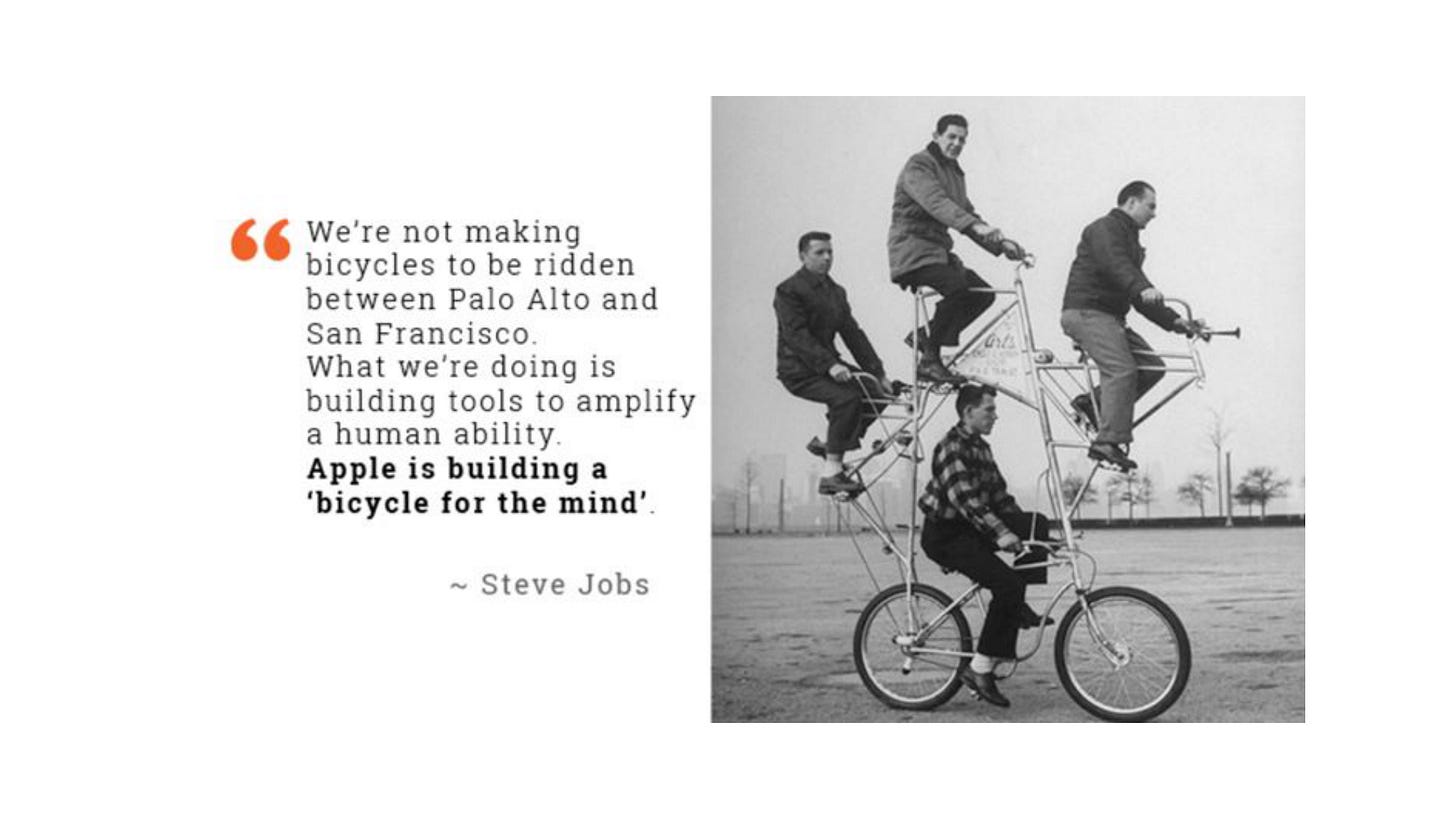
A good goal for a thought leader: create the analogy that will survive you.
5. Be Strongly Opinionated
This is rank five — lower than credibility, aspiration, authority, and being quotable. Why? Because there are a lot of people with strong opinions and no credibility. swyx’s word for it: bloviating. They go viral on Twitter, but nobody respects them. In the long run, they’re what people call an NPC.
Where the authoritative thought leader has a better vision of the past (like Mary Meeker), the strongly opinionated leader has a better vision of the future:
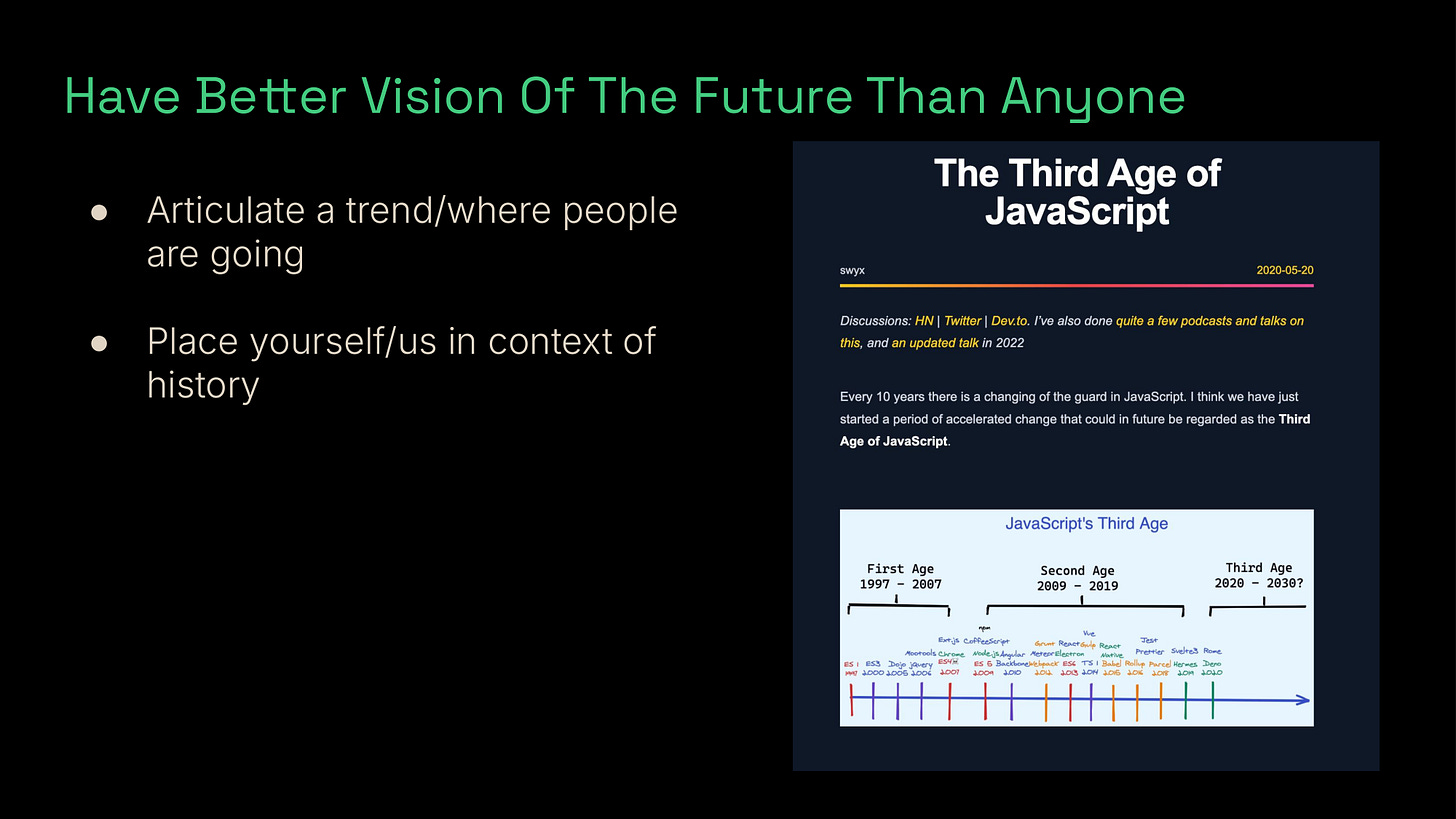
swyx’s “Third Age of JavaScript” — a 20-year timeline with a 10-year extrapolation. History gives your predictions weight.
Be willing to alienate some people. If you’re confident you’re on the right side of history, that’s the cost of having something meaningful to say.
6. Be First, or Be Funny
This comes from Sonal Chokshi’s former editor at a16z: in media, you have to be first or you have to be last.
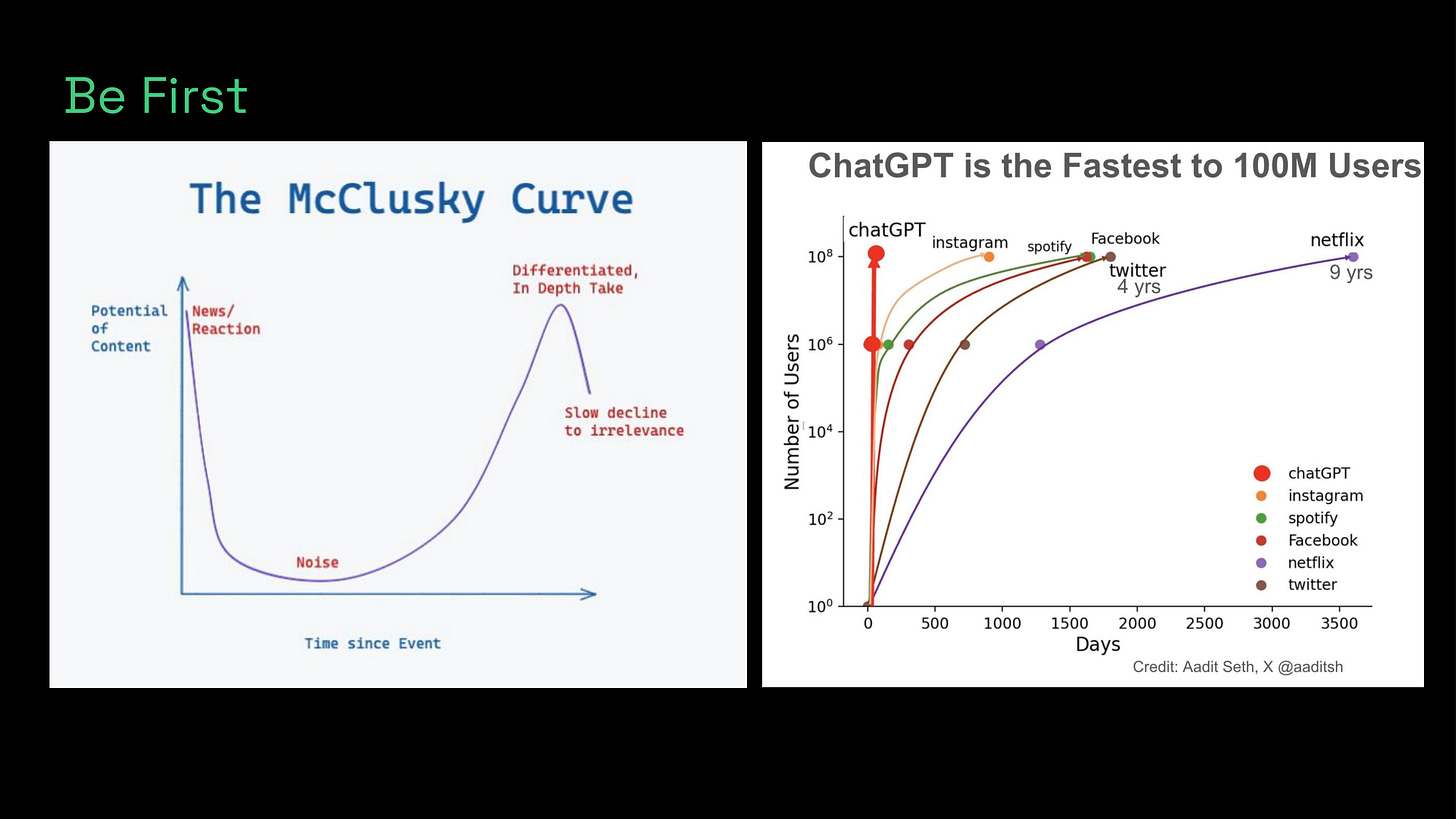
The McClusky Curve: there’s a spike of potential when news breaks, then noise. The differentiated in-depth take comes later — but you need to be in the first wave or the last wave, not the middle.
In AI news cycles, your opinion should be out by 2-3 PM Pacific that day if you want to be quoted. Something launches at 9 AM, everyone posts between 10 AM and 1 PM, and by the next morning the cycle has moved on.
Or, if you can’t be first, be funny:
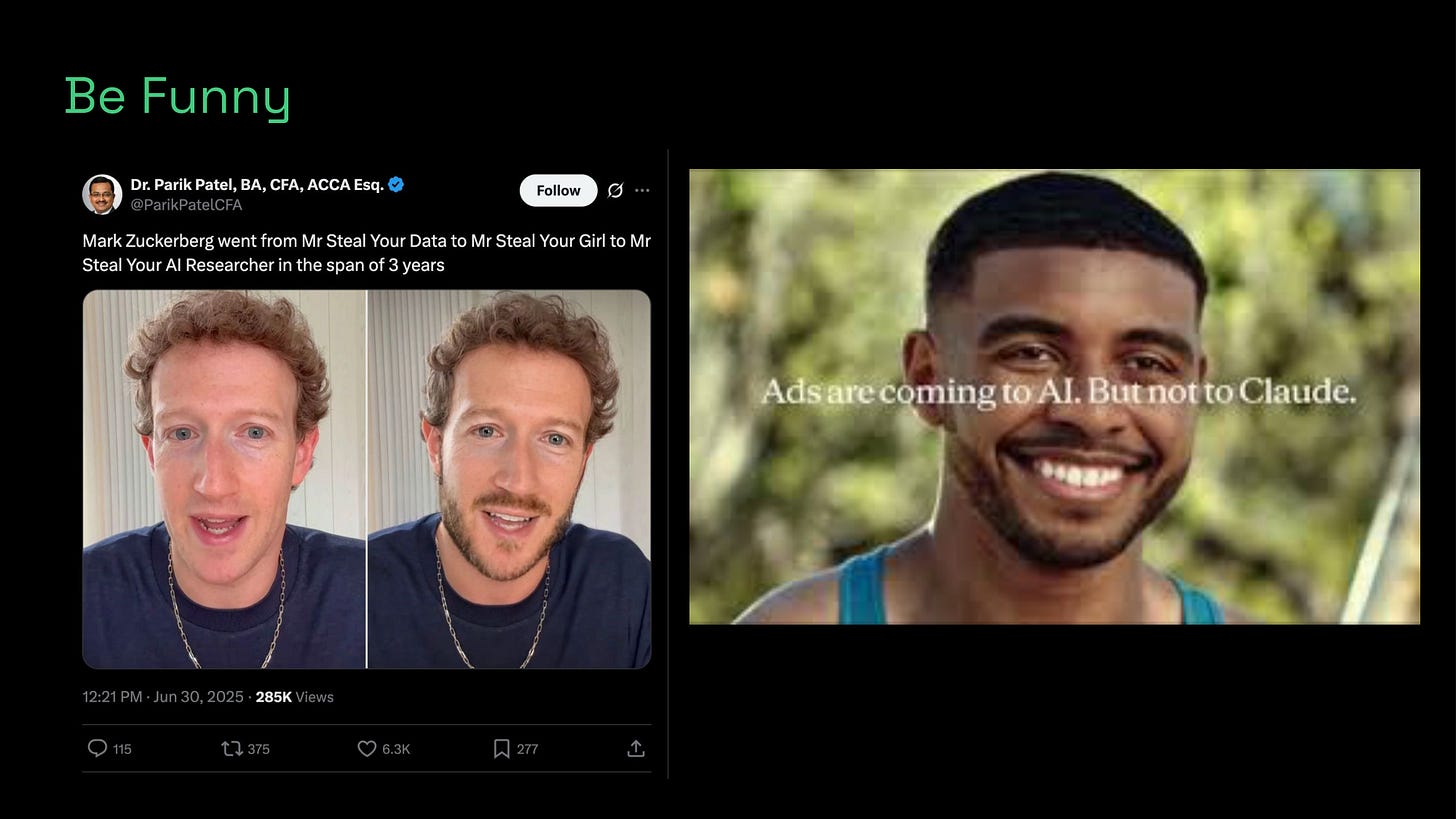
Being funny is lower-ranked than credibility, but it’s still on the board — and you’re not.
Jonah Berger’s research (from Contagious) shows that high-arousal positive emotions — awe, excitement, humor — drive shares. Negative emotions drive clicks but not shares.
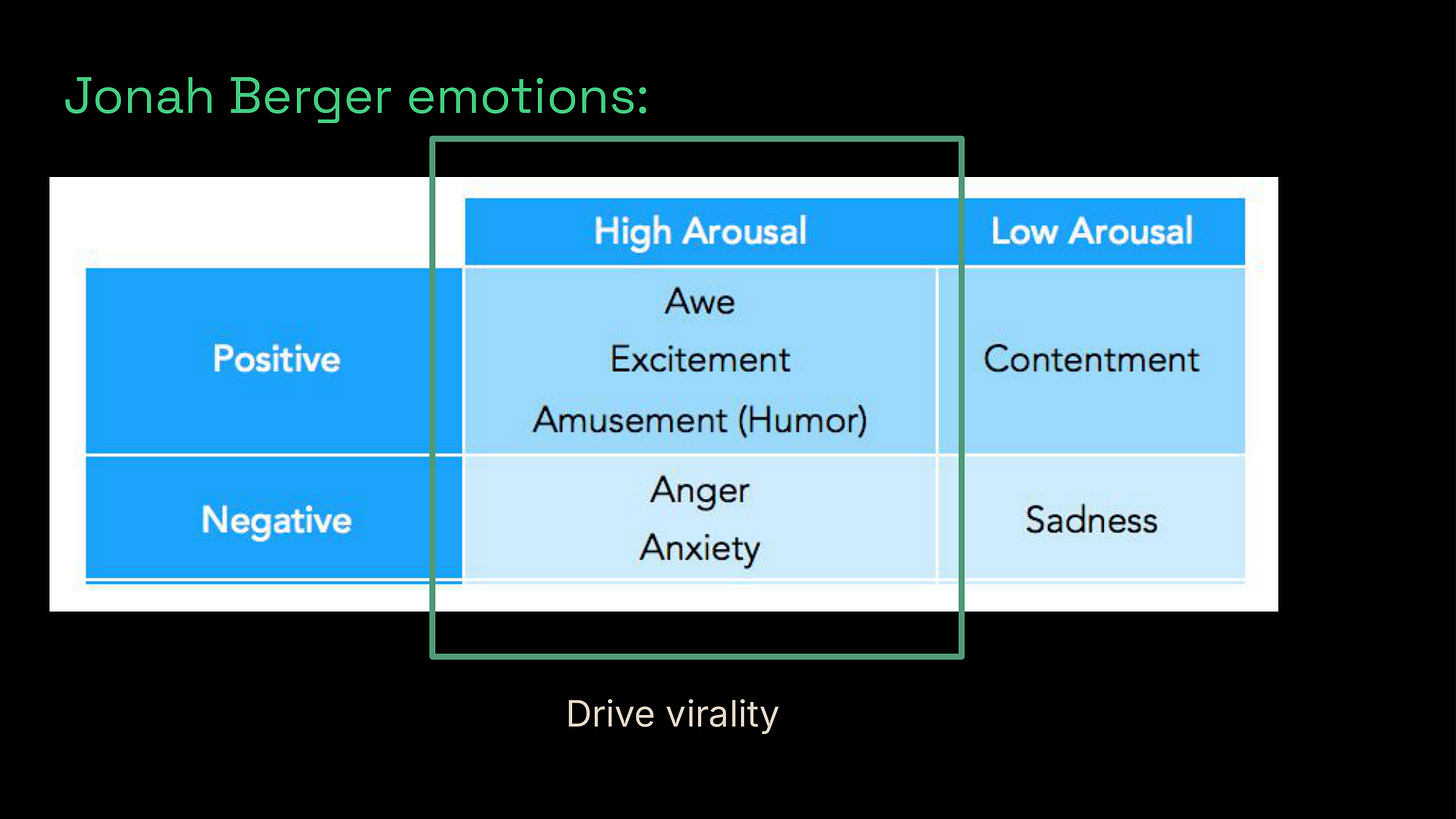
Clickbait (anger, anxiety) gets attention but doesn’t build thought leadership. Awe and excitement are the viral sweet spot.
swyx actually took one class with Jonah Berger at Wharton, right after Berger got tenure. The lesson that stuck: if you want people to spread your ideas, make them feel inspired, not angry.
The Formula
swyx closed by recursively applying his own framework — making this framework itself quotable, visual, and formulaic:
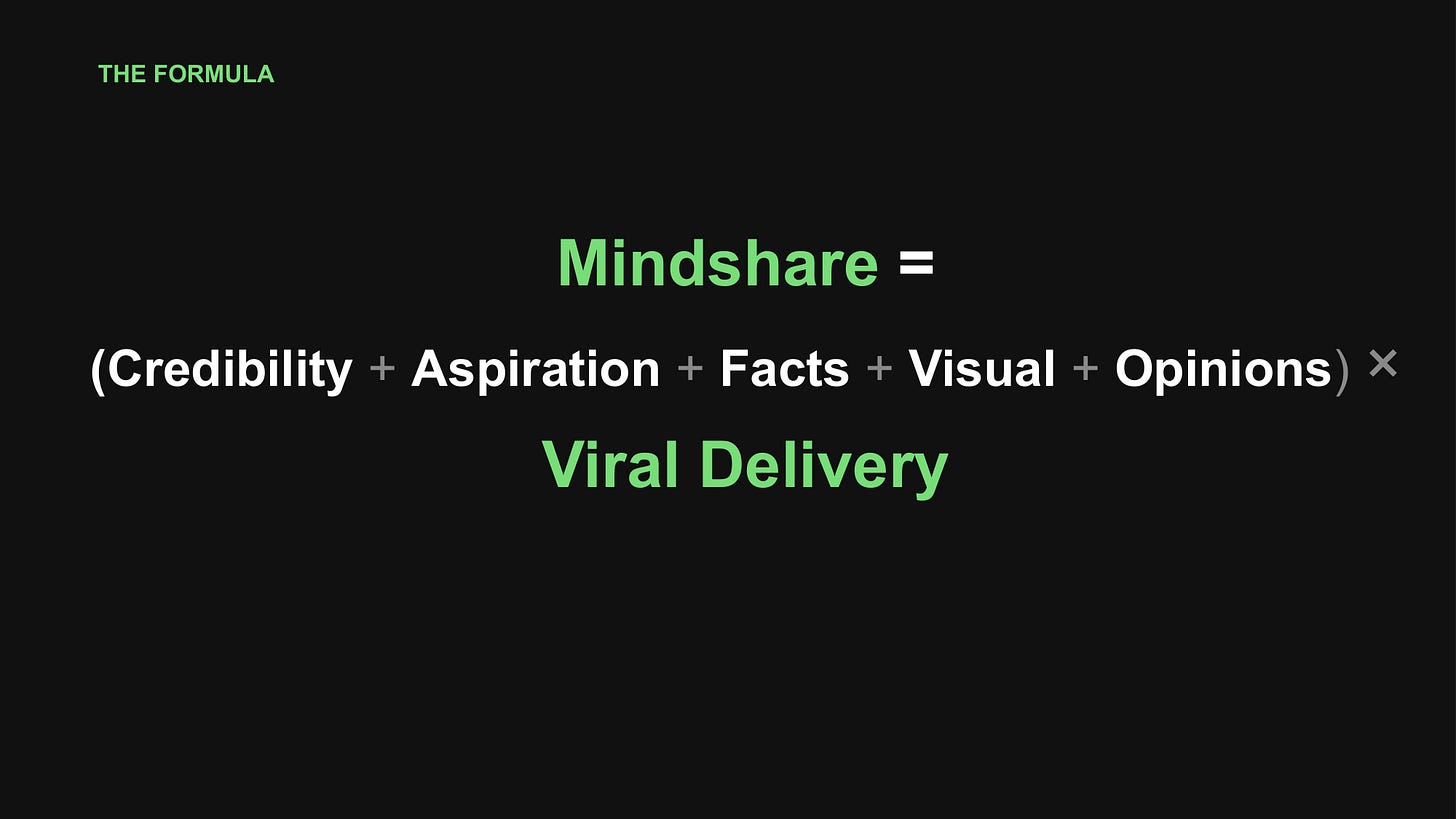
It’s a formula (quotable). It’s a visual. It’s a simplification. It practices what it preaches.
Why This Matters (With Numbers)
Upside did this webinar because we believe good thought leadership matters — but it’s hard to measure, so many marketers default to the easy, measurable things: repurposing others’ content, citing the same research everyone else does, hiring ghostwriters for generic weekly posts.
But real thought leadership does influence revenue:
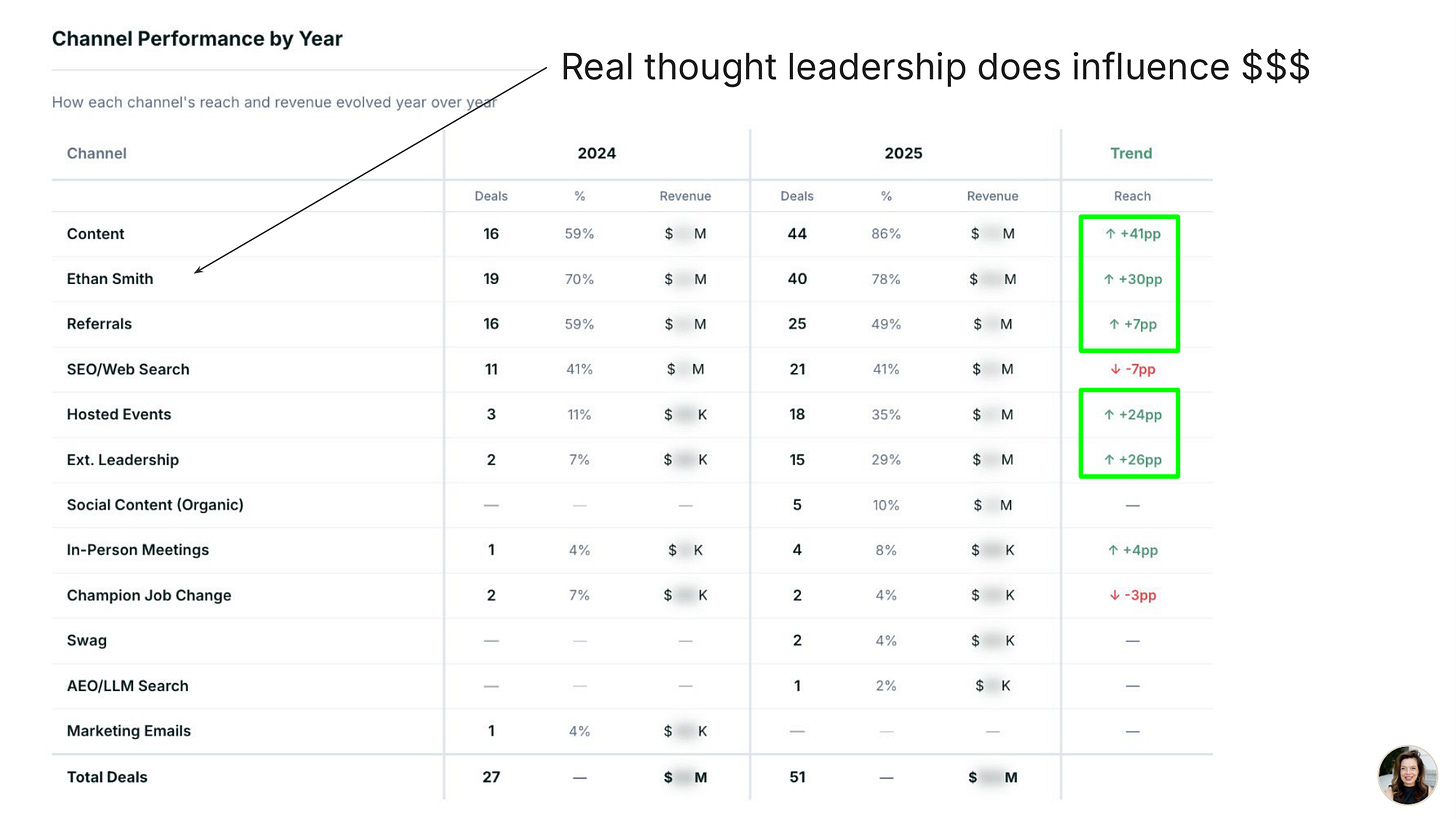
Data from Ethan Smith’s company showing that his personal thought leadership (content + his own name as a channel) touches 86% of deals and 78% of revenue. External leadership reach grew +26pp year over year.
When we looked at Ethan Smith ‘s data, his personal thought leadership is one of his company’s biggest revenue drivers — content touches 86% of deals, and he himself as a channel touches 78% of revenue. That’s the business case for doing this work seriously.
The Meta-Lessons
A few things struck me from this conversation that didn’t fit neatly into the framework but felt important:
The best thought leadership is selfish. swyx tweets because he wants public notes. He writes a daily newsletter because he wants a searchable database of AI news. He builds charts because he needs them to explain things. The audience benefits are a side effect of solving his own problems. This is what makes it sustainable — it’s a single-player game first that becomes multiplayer.
Build assets, not content. Most content is disposable. An asset compounds. swyx’s LLM pricing chart took three hours to build and two minutes to update. Every new model launch makes it more valuable. Ask yourself: what can I build once that gets better every time the world changes?
Simplicity is intelligence. AI can generate complex infographics with robots and purple lines everywhere. But the real thought leadership work is reducing everything to three white boxes and three words. It takes more thinking to make something simple than to make it complex.
Start from the top, not the bottom. Bad thought leaders start with humor and hot takes, then try to build credibility. Good ones do the work first, earn credibility, and let everything else amplify a foundation that’s already solid.
*swyx has been writing publicly since 2018 and has built a following of over 625k subscribers across Latent Space and AI Engineer. His essays “Learn in Public,” “How to Create Luck,” and “The Rise of the AI Engineer” have shaped how a generation of developers thinks about their careers. You can find him at swyx.io.Upside is solving the GTM efficiency problem with AI. We crawl all of your messy go-to-market data like a search engine to reconstruct the story of what actually happened and what worked on every deal, then aggregate these insights so you can see which investments were most effective and how to allocate every dollar most efficiently. Our team is ex-Branch ($4b valuation, $100m+ ARR), and we’re working with companies like Comply, Cresta, Assembled Graphite and Dscout.*